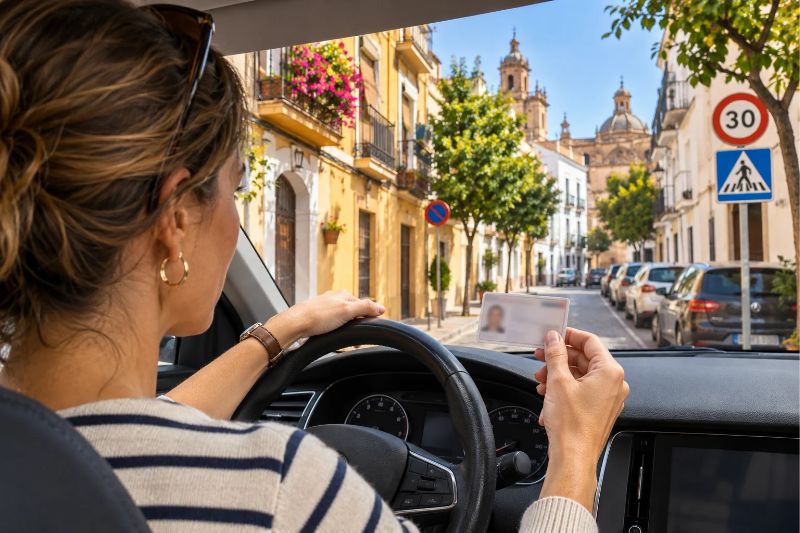
Most Americans assume their driver’s license will simply carry over to Spain, the way it works when you move from Ohio to Texas. It does not. Your U.S. license will get you through your first months, and then the rules change, often sooner than people expect.
SDC International Shipping is a licensed FMC moving company that specializes in relocations from the USA to Spain, and driving comes up with almost every client who ships a car or plans to buy one. This guide explains how long you can drive in Spain on a U.S. license, why you cannot simply swap it for a Spanish one, and how to get a Spanish license before your U.S. one stops counting. If you are still mapping out moving from America to Spain, this is one of the deadlines worth putting on the calendar early, and if you are shipping a vehicle, call us at (844) 651-7050.
Can You Drive in Spain With a U.S. License?
Yes, for a limited time. As a new resident, you can drive in Spain on a valid U.S. license for up to six months from the date you become a normal resident, and after that it no longer counts.
Spain’s traffic authority, the Dirección General de Tráfico (DGT), sets the rule. A foreign license from outside the EU is valid in Spain only while it is in force, while you meet Spain’s minimum age for the equivalent license, and while no more than six months have passed since you acquired normal residence in Spain. Once that window closes, the license is no longer valid for driving in Spain, even though it is still perfectly valid back home.
Normal residence is the place where you habitually live, which the DGT describes as at least 185 days in each calendar year, and for a non-EU national it has to be legal residence you can document. In practice, for most Americans on a residence visa, the clock starts around the time residence begins, not on the day you landed as a tourist on an earlier trip.
Because a U.S. license is in English, the DGT advises getting an International Driving Permit before you travel. The International Driving Permit, or IDP, is an official translation that supplements your license rather than replacing it, it is valid for one year, and you carry it together with your passport and your U.S. license. You have to get it in the U.S. before you leave, through an authorized issuer such as AAA.
Why a U.S. License Cannot Be Exchanged in Spain
A U.S. driver’s license cannot be exchanged for a Spanish one, because Spain has no license exchange agreement with the United States or with any individual U.S. state.
Spain swaps foreign licenses for Spanish equivalents through a process called canje, but only for countries it has signed a bilateral agreement with. Several Latin American countries, Morocco, Japan and South Korea are on that list. The United States is not. In the U.S., licenses are issued by each state rather than by the federal government, so there is no single national authority for Spain to sign an agreement with, and no state has a separate deal of its own.
This catches a lot of Americans off guard, because friends from other countries tell them the exchange is a simple appointment. For a U.S. license holder, it is not an option at all. If you want to keep driving in Spain after your six months run out, you have to earn a Spanish license the same way a first-time Spanish driver does.
How to Get a Spanish Driver’s License as an American Resident
Getting a Spanish license as an American means passing a medical check, a theory exam and a practical driving test, the same steps a new Spanish driver takes.
The medical certificate
Every applicant needs an informe de aptitud psicofísica, a short medical and psychological fitness report issued by an authorized Centro de Reconocimiento de Conductores. These driver testing centers are common in Spanish cities, and you tell them the report is for obtaining a new license.
The theory exam
The theory exam is a multiple-choice test on Spanish traffic law, road signs and safe driving. It is strict, and Spanish rules differ from American ones in ways that cost people points, from roundabout priority to blood alcohol limits. The DGT publishes practice tests online in the same format as the real exam, and the theory test for a car license can be taken in English as well as in Spanish.
The practical driving test
The practical test is an on-road exam with a DGT examiner, conducted in Spanish. Most people prepare through an autoescuela, a Spanish driving school, which provides the dual-control car, coaches you on the local test route and books the exam. Even drivers with decades of experience usually need a few lessons, because the examiner is grading Spanish habits, not American ones.
When you pass the last exam, you receive a provisional permit that lets you drive in Spain while your plastic card is produced. Ask your driving school which new-driver rules, such as displaying an L plate, will apply to you.
Timing Your Spanish License Around Your Move
The safest plan is to start the Spanish license process as soon as your residence is established, because exam slots and driving school waits can eat most of a six-month window.
Six months sounds generous until you add up the steps. You need your residence paperwork in order, a medical certificate, a driving school with space for you, time to study and pass the theory exam, lessons, and then an available practical test date. Waits vary a great deal between provinces, and appointment availability is often the slowest part.
Plan your first months around that clock. Get your IDP before you fly, enroll with a driving school soon after your residence starts, and aim to sit the theory exam early. If your six months run out before you pass, stop driving. A U.S. license past that point is no longer valid in Spain, which means you would be driving without a valid license under Spanish law, and that can also create problems with your car insurance.
Your license timeline also connects to your residence paperwork. The Spanish visa you hold determines when your residence begins, and your residence card is part of the documentation you show at each stage of the license process.
Bringing Your Own Car to Spain
If you ship your car to Spain, it has to be registered in Spain, and you will need a valid Spanish license to keep driving it once your six-month window closes.
The DGT is direct about this: a resident who brings a vehicle from outside the EU must re-register it in Spain before driving it there. Re-registration, called rematriculación, runs alongside customs clearance and includes the ITV roadworthiness inspection. A vehicle can qualify for duty-free entry under the same transfer of residence relief that covers household goods, but the paperwork and inspection run on their own track.
This is where the two deadlines collide. Your car can arrive, clear customs and pass inspection, and you can still be unable to drive it legally if your license window has closed. SDC ships vehicles only inside a container together with your household goods, and our car shipping to Spain page explains how that works. For the customs rules on vehicles and personal goods, see our Spain import rules guide.
Some people decide the license process and the import paperwork are not worth it for a car that will struggle in narrow streets anyway, and buy a smaller car in Spain instead. That is a reasonable choice. Just remember that a car bought in Spain still requires a valid Spanish license once your U.S. one stops counting.
Frequently Asked Questions
How long can I drive in Spain with a U.S. license?
As a resident, you can drive on a valid U.S. license for up to six months from the date you acquire normal residence in Spain. After that, it is no longer valid for driving in Spain, and you need a Spanish license to keep driving. Carry an International Driving Permit with your U.S. license and passport during that period.
Can I exchange my U.S. driver’s license for a Spanish one?
No. Spain has no license exchange agreement with the United States or with any U.S. state, so a U.S. license cannot be swapped through Spain’s canje process. To keep driving after six months as a resident, you have to pass the Spanish theory and practical exams.
Do I need an International Driving Permit in Spain?
Spain’s traffic authority, the DGT, advises drivers from outside the EU to get one before traveling. The IDP works as an official translation of your U.S. license and must be carried together with it and your passport. You have to obtain it in the U.S. before you leave, since it cannot be issued in Spain on a U.S. license.
Can I take the Spanish driving theory test in English?
Yes. The theory test for a car license can be taken in English as well as in Spanish. The practical driving test is conducted in Spanish, so it helps to learn the key instructions an examiner will use.
What happens if I keep driving on my U.S. license after six months?
Once six months have passed since you became a resident, your U.S. license no longer counts as valid in Spain, so you would be driving without a valid license under Spanish law. That can bring fines and can also create problems with your car insurance. Start the Spanish license process early enough to avoid the gap.
Can I ship my car to Spain and drive it on my U.S. license?
You can ship it, but it must be re-registered in Spain, and you can only drive it on your U.S. license during your first six months of residence. After that, you need a Spanish license regardless of where the car came from. SDC ships vehicles inside a container with your household goods.
Plan the License and the Move Together
Driving in Spain as an American comes down to one deadline: six months from residence to hold a Spanish license, with no exchange available to shortcut it.
The people who handle it smoothly treat the license as part of the move, not an afterthought. They get the IDP before they fly, find a driving school in their first weeks, and line up any vehicle shipment so the car and the license are ready around the same time.
SDC International Shipping can handle the shipping side, including a vehicle in your container, so your attention can go to the exams. For the bigger picture, read about moving from the U.S. to Spain, or call (844) 651-7050 and tell us whether a car is part of your plan. We will help you sort out what to ship and when.