You spent years building it. A case from the trip to Napa, the bottles you were saving for a birthday that hasn’t happened yet, the Burgundy a friend talked you into. And now someone at a dinner party has told you that you can’t take wine to Spain, or that it will cost a fortune, and you’re wondering whether to start drinking very fast.
Take a breath. You can ship a wine collection to Spain. It just doesn’t travel on the same terms as your sofa. SDC International Shipping is a licensed FMC moving company that specializes in relocations from the USA to Spain, and wine comes up on our calls more often than most people expect. If you’re planning a move to Spain and the cellar is part of the picture, this guide walks through the duty, the paperwork, the packing and the decisions worth making first. If you’d rather talk it through with someone, call us at (844) 651-7050.
Can You Ship a Wine Collection to Spain When You Move?
Yes, you can ship wine to Spain as part of an international move, but it is declared and taxed separately from the rest of your household goods. Nothing in Spanish rules bans a private collection from arriving in a container. What changes is the cost and the paperwork, because wine is treated as a taxable import even when everything around it comes in tax-free.
That distinction matters, because most people moving from the U.S. qualify for transfer of residence relief. Transfer of residence relief is the customs exemption that lets a person who is moving their home to Spain from outside the European Union bring their used personal belongings without paying import duty or VAT. It covers furniture, clothing, books, kitchenware and the rest of an ordinary household. Spain’s tax and customs authority, the Agencia Tributaria, manages the relief, and it lists a short set of goods that are excluded from it. Alcoholic products sit near the top of that list.
So the honest answer is that your wine can make the trip. It simply gets its own line on the customs declaration and its own bill.
Why Wine Is Excluded From the Household Goods Exemption
Wine is excluded from transfer of residence relief because alcohol and tobacco are taxed goods throughout the European Union, and the exemption was never meant to let them in untaxed. The Agencia Tributaria names alcoholic products, tobacco and commercial vehicles as the items that cannot benefit from the household relief, whatever else is in the shipment.
It doesn’t matter that you’ve owned the bottles for a decade, or that you have no intention of selling them. The rule looks at what the item is, not how long you’ve had it. A dining table you bought last spring may raise questions about whether it counts as used, but a bottle you bought twenty years ago is still alcohol, and alcohol pays.
There is one small exception that people sometimes mix up with the household rules. Travelers arriving from outside the EU have a modest personal allowance for alcohol in their luggage. It covers a few bottles carried with you on the plane, not a shipment, and the Agencia Tributaria publishes the current limits on its traveler pages. If you were hoping to slip a few special bottles through that way, check those limits before you fly, and pack them in your checked bag rather than the container.
What Duty and Taxes Apply to Wine Shipped to Spain From the USA
Wine shipped to Spain from the U.S. pays EU customs duty and Spanish import VAT, and stronger drinks also pay a Spanish excise tax. How much you owe depends on what is in the boxes, which is why the category of each bottle matters as much as the number of them.
Customs Duty
Customs duty is set at the EU level, and for wine it is charged mostly by volume and type, with sparkling and still wines treated differently. American wine gets no preferential rate, so it pays the standard EU tariff. Your customs broker works out the figure using the tariff code for each kind of wine you declare.
Import VAT
Spanish VAT, known as IVA, applies on top. It is calculated on the customs value of the wine plus the duty, at Spain’s standard rate. For most collectors, VAT ends up being the larger part of the bill, which is why the declared value deserves real care.
Excise Tax
Here is the good news for wine lovers. Spain’s Impuesto sobre el Vino y Bebidas Fermentadas, the excise tax on still and sparkling wine, is set at a zero rate, so table wine and Champagne-style bottles avoid it entirely. Fortified wines such as port and sherry are different. They count as intermediate products and fall under a separate excise tax that does carry a charge. Spirits like bourbon, whiskey and cognac fall under the excise tax on alcohol and spirits, which is charged on the amount of pure alcohol and can add up quickly. Rates can change, so confirm them before you decide what to ship.
Put together, a cellar of mostly still red and white wine is far simpler to bring in than a bar cart full of single malts. If your collection mixes the two, it may be worth thinking about them separately. You’ll find more on how Spain treats restricted items in our overview of Spain’s import rules for household shipments.
How to Prepare the Wine Inventory Spanish Customs Needs
A clear, bottle-level inventory is what lets your wine clear Spanish customs without delay. Because the duty and tax depend on type, strength, volume and value, a vague line like “12 boxes of wine” leaves the customs officer guessing, and guessing is where holds and inspections start.
Start with a spreadsheet, even a rough one. For each wine, note the producer, the vintage, the bottle size, how many bottles you have, the alcohol percentage on the label and whether it is still, sparkling or fortified. Then add what you paid, and keep the receipts or purchase records you can find. If some bottles have appreciated, a recent auction result or retailer listing gives you a reasonable basis for value. Declare honestly. Undervaluing wine to lower the tax bill is the sort of thing that turns a routine clearance into a long one.
Keep the wine in clearly labeled boxes that match the inventory, separate from the rest of your belongings. When customs asks to look, and with alcohol they sometimes do, an officer should be able to open one marked carton and find exactly what the list says. This inventory sits alongside the rest of your import paperwork, which is covered in our guide to the customs forms for moving to Spain. The duty and VAT on the wine are paid at clearance, before the container is released for delivery, so plan your budget with that in mind.
Packing and Protecting Wine for the Ocean Crossing
Wine needs purpose-built packing, careful timing and the right insurance to survive a sea crossing in good condition. Breakage is the risk everyone thinks about. Heat is the one that quietly ruins more bottles.
Packing Each Bottle
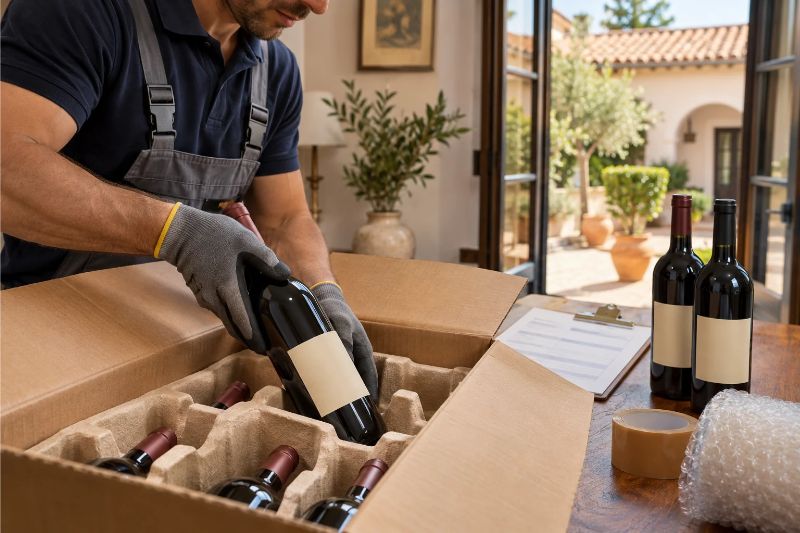
Bottles travel best in molded wine shippers, the foam or pulp inserts that hold each bottle apart, inside sturdy outer cartons. Corked bottles are usually packed lying down so the corks stay in contact with the wine, and the cartons are loaded so they can’t shift or be crushed by heavier items. This is not a job for leftover moving boxes and newspaper. Our professional packing services include fragile and high-value items, and wine belongs in that category.
Heat and Timing
A standard shipping container is not climate controlled. On a port in summer, the inside can get hot enough to damage fine wine, and an ocean move to Spain takes several weeks door to door. That’s why many collectors time the wine for the cooler months, or ship only the bottles that can handle some variation and arrange separate, temperature-controlled transport for the truly valuable ones. If your collection is worth protecting, raise the timing question early, before the move date is fixed.
Insurance
Marine insurance can cover wine, but policies often treat it differently from ordinary household goods, and some limit or exclude damage from heat or spoilage. List the wine separately with its value, and read what the policy says about breakage and temperature before you rely on it. Our page on international moving insurance explains how coverage works for a move to Spain.
Frequently Asked Questions
Do I have to pay duty on wine I ship to Spain with my household goods?
Yes. Alcohol is excluded from Spain’s transfer of residence relief, so your wine pays EU customs duty and Spanish import VAT even if the rest of your shipment comes in tax-free. Still and sparkling wine carry a zero excise rate in Spain, but fortified wines and spirits do not.
Is it cheaper to ship wine or spirits to Spain?
Wine is usually far cheaper to bring in. Still and sparkling wine avoid Spanish excise tax entirely, while spirits pay an excise charge based on their pure alcohol content on top of duty and VAT. A shelf of bourbon can cost more to import than several cases of red.
Can I bring a few bottles of wine in my suitcase instead?
You can bring a small amount tax-free under the traveler allowance for arrivals from outside the EU. It is meant for a handful of bottles, not a collection. The Agencia Tributaria publishes the exact limits, so check them before you pack your bag.
What information does customs need about my wine?
Spanish customs needs to know what each wine is, how much of it there is and what it is worth. A good inventory lists the producer, vintage, bottle size, quantity, alcohol percentage, type and value of each wine, backed by receipts where you have them. The clearer the list, the smoother the clearance.
Will my wine be damaged by heat in a shipping container?
It can be, which is why timing matters. Standard containers are not climate controlled and can heat up in summer ports. Shipping in cooler months, or sending your most valuable bottles separately in temperature-controlled transport, cuts the risk considerably.
Deciding Which Bottles Make the Trip to Spain
The smartest wine moves start with a decision about which bottles are worth the duty, the packing and the risk. Very few collectors ship everything, and there’s no rule that says you should.
Some bottles are irreplaceable. The vintage from your wedding year, the gift from a parent, the case you’ve been aging for a reason. Those usually earn a place. Everyday drinking wine almost never does, because Spain will hand you excellent bottles for a fraction of the trouble. In between sits the rest of the cellar, which you might drink with friends at a series of farewell dinners, sell, or leave in storage in the U.S. until you know where you’ll live. Each of those is a perfectly good answer. You don’t need to have it all decided today, either. Plenty of people sort the cellar in stages as the move date gets closer.
Once you know what’s coming, we can fit the wine into the wider plan for moving from the U.S. to Spain, from packing and inventory to the customs declaration and the timing of your container. Give us a call at (844) 651-7050 and tell us about the collection. We’ll help you work out what’s worth sending and how to get it there in one piece.