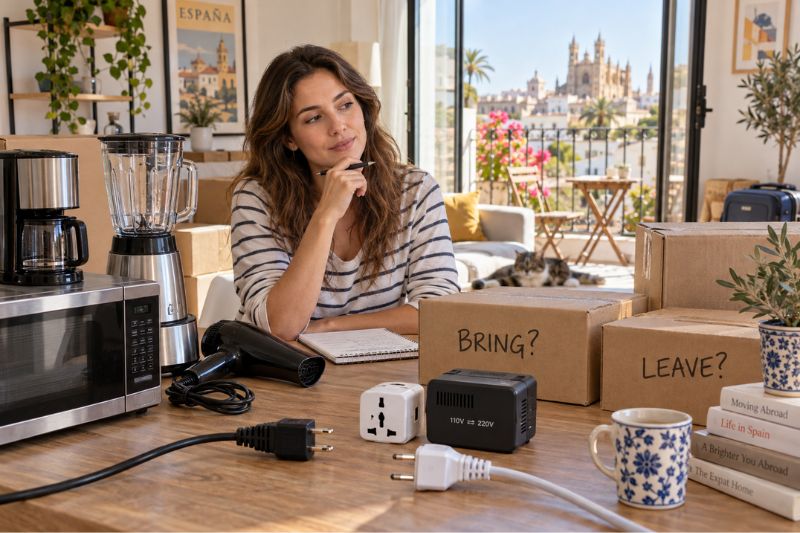
Somewhere in the middle of sorting your kitchen into keep, sell, and donate piles, a nagging question shows up: will any of this even work in Spain? It is a good question to ask before the movers arrive, not after. A single wrong plug can ruin a blender in seconds, and nobody wants to learn that on their first night in a new home.
SDC International Shipping is a licensed FMC moving company that specializes in relocations from the USA to Spain, and appliances are one of the most common things clients ask us about when they start planning how moving to Spain works. This guide explains what voltage and plugs Spain uses, which American appliances will run safely, and which ones are better left behind.
What Voltage and Plugs Does Spain Use?
Spain runs on about 230 volts at 50 hertz and uses round-pin Type C and Type F plugs, while the United States runs on 120 volts at 60 hertz with flat-pin plugs. Voltage is the strength of the electricity, frequency is how fast it alternates, and both have to match your appliance. A mismatch in either one can damage the device or create a safety risk.
Those two differences are why a plain American appliance cannot simply be carried over. The plug shape is the obvious problem, and the easy one to solve. The voltage and the frequency are the quieter problems, and they are the ones that cause damage.
Do You Need a Plug Adapter, a Voltage Converter, or Neither?
The label on your device decides this, because a plug adapter only changes the shape of the plug and does nothing to the electricity. If the label says the device accepts 100 to 240 volts, an adapter is all you need. If it says 120 volts only, an adapter alone will send 230 volts into a device built for 120, and that usually ends in a burned-out appliance.
A step-down transformer, sometimes called a voltage converter, does the other job: it brings Spain’s 230 volts down to the 120 volts an American device expects. Pick one rated comfortably above the wattage of whatever you plug into it, since an undersized transformer overheats. Keep one more point in mind. A transformer fixes voltage but does not change frequency, so it does not make a 60-hertz appliance happy on Spain’s 50-hertz supply.
Which American Appliances Work in Spain With Just an Adapter?
Most modern electronics work in Spain with only a plug adapter, because they are built to accept a wide range of voltages. Laptops, phone and tablet chargers, e-readers, cameras, and many power adapters carry a label reading something like 100-240V, 50/60Hz. That label is your green light, and it takes ten seconds to check on each charger.
Many televisions, gaming consoles, and small speakers also fit this category, but check each one instead of assuming. Look for the input rating printed on the power brick or the back of the device. A single multi-outlet adapter with a built-in surge protector often handles a whole desk of dual-voltage gear.
Which Appliances Should You Leave in the U.S.?
Leave behind anything that heats, spins, or keeps time off the mains and is rated for 120 volts only. That list includes hair dryers, toasters, kettles, space heaters, microwaves, blenders, stand mixers, vacuum cleaners, and the big appliances, such as refrigerators, washers, and dryers.
Heating appliances draw a lot of power, so the transformer needed to run them is large and heavy, and at that point you are shipping extra weight to power something that costs less to replace locally. Motors face a separate problem. A motor built for 60 hertz runs slower on Spain’s 50 hertz, which can cause overheating, premature wear, or outright failure, and no transformer fixes that. Some manufacturers go further and advise against using transformers abroad at all, and taking an appliance overseas can void its warranty. Simple clocks and timers that count the electrical cycles will also run slow.
Large appliances have a practical issue beyond electricity. Spanish kitchens and laundry spaces are often compact, and American refrigerators and washers may not fit the space or the plumbing connections. Buying locally means the machine matches the home, the outlets, and the warranty.
Is It Worth Shipping Appliances to Spain?
For most people, the smartest move is to ship dual-voltage electronics and replace single-voltage kitchen and laundry appliances once you arrive. Shipping a 120-volt appliance means paying to move it, then paying again for a transformer, and still risking a motor that was never built for 50 hertz.
There are real exceptions. An expensive dual-voltage device, a piece of professional equipment, or something with deep sentimental value can earn its space in the container. If you are unsure, ask what the replacement would cost compared with the cost of moving it and adapting it, and remember that the freed container space can carry things you cannot replace, like family photos or a favorite chair. If you are planning a short stay in a furnished rental, the answer is even simpler: bring chargers and laptops, skip the rest.
Spain’s customs clearance also looks at your inventory, so list each appliance you do ship honestly, with its brand and model. Our guide to Spain import rules explains what customs expects, and our page on what you can and can’t ship to Spain covers the restricted items that matter alongside electronics.
How Do You Pack and Ship Electronics and Appliances to Spain?
Pack electronics in their original boxes when you still have them, label dual-voltage devices clearly, and keep the small, irreplaceable ones with you instead of in the container. Padding matters more for screens and computers than for anything else, and cords and chargers should travel with their device so nothing gets separated in transit.
Our professional packing services use materials built for international transit and inventory each electronic item as it is packed, which also helps with the customs file. For the bigger picture of Spain household moving logistics, that page explains how a shipment is planned from first survey to delivery, and our international movers to Spain overview shows how all the pieces fit together.
If you are staring at a pile of cords and wondering what to keep, call us at (844) 651-7050. Send us a list of what you are unsure about, and we will help you sort it before you pay to move anything you will end up replacing.
Frequently Asked Questions
What voltage does Spain use?
Spain uses about 230 volts at 50 hertz. The United States uses 120 volts at 60 hertz, so most American appliances are not built for Spain’s supply unless their label says otherwise.
Can you use a U.S. laptop or phone charger in Spain?
Yes, in almost every case, with only a plug adapter. Check the charger for a rating like 100-240V, 50/60Hz, which means it handles Spain’s electricity on its own.
Can you plug a U.S. appliance into a Spanish outlet with an adapter?
Only if the appliance is dual voltage. A plug adapter changes the shape of the prongs, not the voltage, so a 120-volt-only appliance will receive 230 volts and is likely to be damaged.
Do you need a transformer for U.S. appliances in Spain?
For any 120-volt-only appliance, yes, a step-down transformer rated above the device’s wattage is required. For heaters, hair dryers, and other high-wattage items, the transformer is large and heavy, which is why replacing them locally usually makes more sense.
Will U.S. appliances work at 50 hertz?
Not always. Motors built for 60 hertz run slower on 50 hertz and can overheat or fail, and a voltage transformer does not correct the frequency. Electronics with a 50/60Hz label are designed for both.
Should you bring your kitchen appliances when moving to Spain?
Most people leave them. Single-voltage blenders, mixers, microwaves, and toasters are cheaper to replace than to ship and adapt. The exception is a dual-voltage item you love, which only needs a plug adapter.