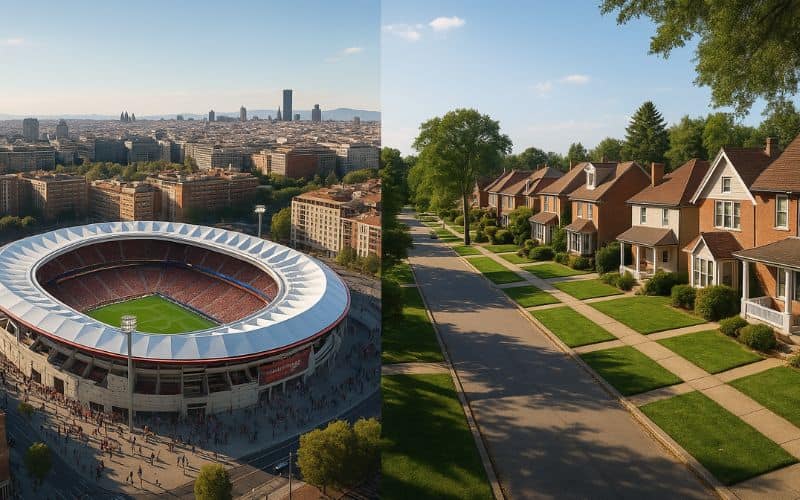
Introduction: why stadium neighborhoods matter for expats
For many Americans considering a move to Spain, football — or soccer, as it is known back home — is one of the first cultural touchpoints they encounter. Spain is home to La Liga, one of the most prestigious football leagues in the world, and its clubs are not just sports teams but social institutions that shape neighborhoods, traditions, and even local economies. Moving to a city with a La Liga club means that football will be part of the rhythm of your daily life, whether or not you are a devoted fan.
Stadium neighborhoods are a world of their own. On match days, the streets come alive with fans waving scarves, chanting songs, and spilling into cafés for pre-game beers and tapas. Public transport surges with energy, and local businesses thrive on the influx of supporters. For a few hours, the atmosphere is electric and communal, and even expats who never followed football before often find themselves swept up in the excitement. But what about the rest of the week, when there is no game? These neighborhoods revert to being what they have always been: residential communities with schools, bakeries, parks, and the ordinary rhythms of Spanish life.
That dual identity makes stadium neighborhoods both appealing and complicated for expats. On the one hand, living near a La Liga stadium means proximity to culture, energy, and often convenient transport links. On the other, you may have to deal with crowds, traffic, and occasional noise. The choice is not just about football; it is about lifestyle. Retirees, professionals, and families will each weigh the pros and cons differently.
For expats moving from the United States, where sports stadiums are often isolated in suburban zones surrounded by parking lots, the idea of living in a neighborhood that includes a major stadium can feel surprising. In Spain, stadiums are usually embedded into the fabric of the city itself, part of districts that existed long before the club became world famous. That means you are not just living near a stadium, you are living inside a community that has grown up around it, with deep ties to the club and its history.
This guide explores what it is like to live near some of Spain’s most iconic La Liga stadiums, starting with Madrid, the capital city that hosts two of the league’s giants: Real Madrid and Atlético Madrid. Each has its own neighborhood, culture, and housing options, and each offers a very different experience for American expats looking to settle in Spain.
Madrid, Santiago Bernabéu and Civitas Metropolitano
Madrid is unlike any other city in Spain because it is home to two global football giants, Real Madrid and Atlético Madrid. Both clubs dominate international headlines, both inspire loyal local followings, and both shape the neighborhoods where their stadiums stand. For expats, the decision to live near the Santiago Bernabéu or the Civitas Metropolitano is not just about football allegiances; it is about choosing between two distinct lifestyles.
The Santiago Bernabéu, Real Madrid’s legendary stadium, sits in the Chamartín district. This is one of Madrid’s most prestigious and modern neighborhoods, known for its business centers, financial hubs, and high-quality housing. Wide avenues, leafy boulevards, and easy access to metro lines make the area highly desirable for professionals and international families. Living here means paying higher rents or purchase prices compared to many other parts of Madrid, but it also means living in a well-connected district with excellent services.
On match days, Chamartín transforms. Streets fill with fans clad in white, chanting club songs as they head toward the stadium. The atmosphere is celebratory but also intense, with traffic restrictions and large crowds temporarily altering the quiet flow of the neighborhood. For expats who love the energy of football, this is part of the charm; for those who value peace, it may require adjustment. Between games, however, the area settles back into a polished urban rhythm, with upscale cafés, supermarkets, and parks where families gather.
Across town, Atlético Madrid’s Civitas Metropolitano offers an entirely different experience. Located in the eastern suburbs, this modern stadium sits in a growing residential zone that feels less polished but more accessible for many families. Housing here is generally newer and more affordable than in Chamartín, and the community atmosphere is down-to-earth and family-friendly. Parks, schools, and playgrounds are plentiful, and the vibe reflects the club’s reputation as a team with working-class roots. On game days, the neighborhood comes alive with red-and-white scarves, but the crowds are often more localized, and the energy feels less overwhelming than the throngs around the Bernabéu.
From a housing perspective, expats face different trade-offs. In Chamartín, expect modern apartments with sleek designs but limited space compared to American standards. Suburban areas near the Metropolitano, by contrast, may offer larger homes or duplexes at a more affordable rate, making them attractive for families with children or retirees looking for space. Both areas are well connected to Madrid’s metro and bus network, but Chamartín places you closer to the city’s cultural core, while the Metropolitano’s location feels suburban, with easier road access but longer commutes to central attractions.
Moving logistics reflect these differences too. Chamartín’s dense streets and apartment buildings can make direct container deliveries challenging. Expats moving into this area often rely on Groupage Shipping to Spain for smaller loads, supported by Secure Storage until they find the right apartment. Our Professional Packing Services also play a key role, ensuring fragile items are packed compactly for urban deliveries where space is at a premium.
Near the Civitas Metropolitano, larger roads and more spacious housing developments make full container deliveries more feasible. Retirees or families who want to bring entire households often choose Sea Freight Shipping for direct moves into suburban homes. The additional space also makes it easier to unpack at your own pace, without feeling pressured to fit everything into a compact city apartment.
In both cases, SDC coordinates every step, from pickup in the U.S. to customs clearance in Spain, ensuring your household goods arrive when and where you need them. Whether you choose the upscale rhythm of Chamartín or the suburban comfort near the Metropolitano, the key is to align your housing decision with your lifestyle priorities, and to plan your move accordingly.
Barcelona, Camp Nou and the Les Corts neighborhood
Barcelona is synonymous with FC Barcelona, one of the most famous clubs in the world. Its stadium, Camp Nou, sits in the Les Corts district, a neighborhood that blends residential calm with the vibrant heartbeat of one of Europe’s most visited cities. For expats, living near Camp Nou means being part of the city’s everyday life as well as its football culture, and that combination can be both exhilarating and demanding.
Les Corts is a largely residential district located west of the city center. It is well connected by metro and bus, with easy links to Plaça de Catalunya and Barcelona’s main attractions. The neighborhood offers a mix of mid-rise apartment buildings, leafy avenues, local shops, and schools, making it popular with families as well as professionals who want a quieter pace while remaining close to the city’s core. Unlike the tourist-heavy Gothic Quarter or El Born, Les Corts feels more authentically Barcelonés, where daily life revolves around bakeries, markets, and local cafés.
On match days, however, the area around Camp Nou transforms. Tens of thousands of fans pour into the streets, filling bars, restaurants, and plazas with the blaugrana colors of FC Barcelona. Public transport is packed, and traffic reroutes around the stadium. For some expats, this energy is a thrilling part of the experience of living in Barcelona; for others, it is a logistical hassle to plan around. It is worth noting that FC Barcelona is in the middle of renovating the stadium (expected to finish by 2026), so expats moving in 2025 will be living near a major construction site as well as one of the most iconic football venues on earth.
Housing in Les Corts ranges from modern apartments to older buildings with classic Catalan charm. Prices here are generally lower than in Eixample or other central districts, but they are higher than in Barcelona’s outer suburbs. Many apartments are compact by American standards, with limited storage and smaller kitchens, but the neighborhood compensates with accessibility and local amenities. For expats who want to be close to the stadium and still within reach of Barcelona’s cultural life, Les Corts is an attractive option.
Living in this area also puts you close to schools, including some international options, and hospitals such as Hospital Clínic and Sant Joan de Déu. For retirees, the walkable environment and proximity to medical services add convenience. For younger professionals or digital nomads, the neighborhood offers quiet residential streets with easy access to coworking hubs in central Barcelona.
Moving logistics in Barcelona require careful planning. Streets near Camp Nou are narrower than American expats may expect, and apartment buildings often lack large elevators. That makes Professional Packing Services essential for ensuring items are compact and protected during delivery. Many expats moving into Les Corts prefer Groupage Shipping to Spain for a smaller initial load, then use Secure Storage until they secure a long-term lease. For families bringing more, Sea Freight Shipping remains an option, though it requires coordination to navigate city deliveries.
Ultimately, living near Camp Nou is about balance. You gain the authenticity of a real Barcelona neighborhood, close to schools and shops, with the added thrill of football culture woven into daily life. The challenge lies in adapting to the rhythm of match days and the ongoing stadium renovation. For many expats, though, the rewards far outweigh the disruptions, making Les Corts one of Barcelona’s most dynamic districts for international residents.
Valencia, Mestalla and the student-friendly heart of the city
Valencia is Spain’s third-largest city, and its football club, Valencia CF, is at the heart of local identity. Mestalla, the club’s historic stadium, is located just east of the city center in a lively area that combines residential life with the energy of one of Spain’s great cultural capitals. For expats, living near Mestalla offers a blend of affordability, accessibility, and community spirit that makes Valencia a compelling alternative to Madrid or Barcelona.
The Mestalla neighborhood is a hub of daily activity. By day, its streets are lined with cafés, supermarkets, and small shops. By night, the area comes alive with students, young professionals, and football fans. Valencia is home to several universities, and Mestalla is within walking distance of campuses, making the area particularly popular with students and international residents. This gives the neighborhood a youthful, vibrant energy that is less polished than Madrid’s Chamartín or Barcelona’s Les Corts but deeply engaging for those who want a lively community.
On match days, Mestalla is a sea of orange and white. The stadium is one of the oldest in Spain, and its steep stands create a unique atmosphere that spills into the streets. Fans gather hours before kickoff, and local businesses thrive on the influx. For expats living nearby, it is important to plan around this surge, but many come to see it as part of the charm. The passion of Valencia CF supporters is contagious, and even those who were not football fans often find themselves attending games just to be part of the experience.
Housing in Mestalla is diverse. The area offers older apartments with character, modern buildings with more amenities, and plenty of options that are affordable compared to Madrid or Barcelona. Rents are significantly lower than in Spain’s two biggest cities, making Valencia a strong choice for retirees on fixed incomes or young expats starting careers abroad. Apartments may be smaller than American homes but tend to be larger than comparable units in central Barcelona. For families, the affordability of housing allows for more space, and nearby parks and playgrounds make the area family-friendly.
One of the strongest advantages of living in Mestalla is accessibility. The neighborhood is within walking distance of Valencia’s historic center, with its stunning cathedral, plazas, and bustling markets. It is also close to the Turia Gardens, a vast park built in a former riverbed, which provides a green space for walking, biking, and socializing. For retirees and families, this proximity to both culture and leisure activities is a major benefit.
Moving logistics in Valencia are generally easier than in Madrid or Barcelona. Streets are wide enough for container trucks in many areas, and housing often includes better storage than in denser cities. Expats moving into Mestalla can often use Sea Freight Shipping for full households without the challenges of narrow city deliveries. For those who prefer a phased move, Groupage Shipping to Spain remains a good option, while Secure Storage helps bridge the gap between temporary and permanent housing.
Healthcare is also accessible, with several clinics and hospitals nearby, and international schools are within commuting distance for families. Combined with Valencia’s reputation for lower overall cost of living and its Mediterranean climate, the Mestalla area represents one of the best balances of affordability, convenience, and lifestyle for American expats.
For those who love football, living near Mestalla means being part of a passionate, historic club. For those who simply want a central, accessible neighborhood in a city that offers culture, beaches, and affordability, it is equally appealing. Expats often find that Valencia combines much of what they love about Madrid and Barcelona at a more manageable scale, and the Mestalla district embodies that balance perfectly.
Seville, Ramón Sánchez-Pizjuán and Benito Villamarín
Seville is unique among Spanish cities because it is home to two major La Liga clubs: Sevilla FC and Real Betis. The rivalry between the two teams is one of the most passionate in the league, and their stadiums define two distinct neighborhoods. For expats, choosing between them is not simply about football loyalties, it is about choosing between two very different lifestyles and housing options within the same city.
The Ramón Sánchez-Pizjuán Stadium, home to Sevilla FC, sits in the Nervión district. Nervión is one of Seville’s most desirable residential areas, known for its shopping centers, wide streets, and excellent transport connections. It is a polished, modern neighborhood that appeals to families and professionals alike. Housing here consists largely of mid-rise apartments, many of which are spacious compared to those in Madrid or Barcelona. Prices are higher than in some other parts of Seville, but still lower than Spain’s larger cities, making Nervión an attractive option for expats who want convenience, services, and a safe, comfortable atmosphere.
Match days in Nervión bring a surge of fans wearing Sevilla’s red and white. Streets fill with chants and flags, and the excitement spills into bars and cafés. While traffic can be challenging during these hours, the area quickly returns to its residential calm after games. For expats, this rhythm can be part of the charm of living in a neighborhood that balances daily life with bursts of cultural passion.
Across the Guadalquivir River lies Benito Villamarín Stadium, home to Real Betis. The neighborhood here feels more local and down-to-earth compared to Nervión. Housing is more affordable, with a mix of older apartments and newer developments. The vibe is less polished, but many expats find it authentic and welcoming, with a strong sense of community. Parks and open spaces make it appealing for families, while younger expats appreciate the area’s lively, neighborhood-focused bars and eateries.
On match days, the area around Villamarín explodes with green and white, the colors of Betis. The atmosphere is famously festive, reflecting the club’s reputation as the “people’s team” of Seville. For expats who want to feel part of a community with deep local pride, living near Villamarín offers an immersive cultural experience.
From a logistics standpoint, both Nervión and the Betis neighborhood are easier to navigate than denser cities like Madrid or Barcelona. Streets are wider, housing is more spacious, and parking is more accessible. This makes Sea Freight Shipping practical for expats bringing full households, while those testing the waters with smaller moves may prefer Groupage Shipping to Spain. Our Professional Packing Services are valuable for protecting heirlooms or fragile items, particularly for retirees relocating with family treasures.
Healthcare and education are accessible from both neighborhoods. Seville has well-regarded hospitals and international schools, making it suitable for both retirees and families. The cost of living is lower than Madrid and Barcelona, while the cultural life — from flamenco to festivals like Feria de Abril — is unmatched. For expats who want a city with rich traditions, walkable neighborhoods, and football woven into its fabric, Seville offers two strong but very different choices.
Other La Liga cities, Bilbao, San Sebastián, Villarreal, and Granada
While Madrid, Barcelona, Valencia, and Seville attract much of the international attention, other La Liga cities across Spain provide unique living experiences for expats. These smaller or mid-sized cities are often more affordable, less crowded, and deeply connected to their clubs, offering a lifestyle that feels more authentically Spanish.
Bilbao, in the Basque Country, is home to Athletic Club and its striking San Mamés Stadium. Known as “the Cathedral,” San Mamés is one of the most modern stadiums in Spain, and it anchors a city that blends tradition with innovation. Bilbao is more industrial than touristy, but it has reinvented itself as a hub of art and design, symbolized by the Guggenheim Museum. Living near San Mamés means living in a modern, well-connected part of the city, with housing that is affordable compared to Madrid or Barcelona. The Basque Country is also known for its excellent cuisine and strong sense of community, though expats should be prepared for cooler, rainier weather than in southern Spain.
San Sebastián, just a short distance away, does not host a La Liga giant but is home to Real Sociedad in nearby Anoeta Stadium. San Sebastián is famous for its beaches, cuisine, and quality of life, consistently ranked as one of the best places to live in Spain. Housing is pricier than in Bilbao, reflecting its desirability, but for expats who want a mix of coastal beauty, walkability, and a vibrant football culture, San Sebastián is an exceptional choice.
Villarreal, by contrast, is a small town with a big football club. Known as the “Yellow Submarine,” Villarreal CF punches above its weight in European competitions. Living here means joining a close-knit community where football is central to local identity. Housing is affordable, the pace of life is slow, and the proximity to the Mediterranean coast adds appeal. For retirees or families seeking affordability and a strong sense of belonging, Villarreal offers something unique.
Granada, in Andalusia, is another La Liga city with immense charm. The Estadio Nuevo Los Cármenes is smaller than many of its counterparts, but the city itself is world-famous for the Alhambra, its Moorish heritage, and its location at the foot of the Sierra Nevada mountains. Living in Granada means lower housing costs, vibrant student life (thanks to its large university), and easy access to both beaches and skiing. For expats, it offers one of the best balances of affordability, cultural richness, and natural beauty in Spain.
From a moving perspective, smaller La Liga cities often present fewer logistical challenges. Streets are less congested, housing is larger, and delivery of full containers through Sea Freight Shipping is straightforward. At the same time, these cities often have fewer English-speaking services, meaning expats may need to learn Spanish (or even Basque in Bilbao and San Sebastián) more actively to integrate.
For Americans who want an authentic Spanish experience, these smaller La Liga cities represent an opportunity to combine lower costs with a high quality of life. They may not have the international glamour of Madrid or Barcelona, but they offer something more enduring: community, identity, and a rhythm of life where football is not just a sport, but part of the social glue.
Moving logistics for stadium neighborhoods and the bottom line
No matter which La Liga city you choose, the experience of living near a stadium will shape your daily life in ways that are both exciting and practical. From Madrid’s bustling Chamartín to Seville’s family-friendly suburbs, stadium neighborhoods are deeply woven into Spain’s urban fabric. For American expats, that means planning not only for the cultural rhythm of football but also for the logistics of moving into areas that range from dense city streets to more suburban-style communities.
Urban neighborhoods, like those around Santiago Bernabéu in Madrid or Camp Nou in Barcelona, often present challenges for deliveries. Narrow streets, limited parking, and upper-floor apartments mean that shipments must be carefully staged. Many expats in these areas start with Groupage Shipping to Spain, sending only essentials at first, while placing the rest in Secure Storage until they secure a permanent lease. Our Professional Packing Services ensure belongings are compact and well-protected for apartment deliveries where space is tight.
In more suburban or mid-sized cities, such as areas near Atlético Madrid’s Metropolitano, Valencia’s Mestalla, or Seville’s Villamarín, logistics are often easier. Wider streets and larger homes make Sea Freight Shipping a practical option for full households. Retirees or families moving with furniture and heirlooms may also want to consider Moving Insurance for peace of mind, while specialty services like Ship Artwork to Spain or International Piano Moving Service protect valuable items.
Smaller La Liga towns, such as Villarreal or Granada, are typically the most straightforward for delivery. Streets are less congested, homes are more spacious, and container trucks can often reach directly. For expats who want to save money, Groupage Shipping remains an option, while those setting up a permanent household can benefit from direct container service.
The bottom line is that your choice of stadium neighborhood is about more than football. It is about lifestyle, housing, cost, and how you want to experience Spanish culture day to day. For football enthusiasts, living near a La Liga stadium is a dream come true, with the thrill of match days and the sense of belonging that comes from supporting a local club. For families and retirees, it is about weighing the energy and excitement of city life against the space and calm of suburban or smaller towns.
At SDC International Shipping, we guide you through these decisions and align your moving plan with your lifestyle choice. Whether you are downsizing into a city apartment near a famous stadium or settling into a suburban villa with room for family visits, our Moving Services are tailored to your needs. Start by requesting a Get a Quote, and let us map your shipping, customs paperwork, and delivery to the neighborhood that feels like home. With the right plan, your move to Spain can be as seamless as it is exciting, leaving you free to enjoy your new life, both on and off the pitch.