Madrid doesn’t ease you in. It hits you all at once, the noise and the heat and the smell of good coffee drifting out of every doorway, the sidewalks full of people at midnight on a Tuesday, the sense that the city has been alive for centuries and will be alive long after anyone currently living there has moved on. For Americans who have spent their lives in places designed around the car, the schedule, and the workday, it can feel completely disorienting. And then, usually pretty quickly, it starts to feel like exactly where you were supposed to end up.
More Americans are choosing Madrid as their destination than ever before, and it isn’t hard to understand why. It’s one of Europe’s great capital cities, fully modern and globally connected, with a cost of living that still looks generous compared to New York or San Francisco. The food is extraordinary. The summers are long and dry. And it has a particular energy, social and late-night and unapologetically itself, that tends to get under people’s skin.
Getting there requires some planning. If you’re serious about a move to Madrid, you’ll need to think through where in the city you actually want to live, how to handle the logistics of getting your belongings across the Atlantic, what documents and visas belong on your checklist, and what the experience of settling in actually looks like once you’ve arrived.
At SDC International Shipping, we help Americans with international moving to Spain every day. Madrid is one of our most common destinations. Here’s what we’ve learned.
Getting to Know Madrid Before You Move
Madrid is Spain’s capital and its largest city, home to around 3.3 million people in the city proper and considerably more in the wider metro area. It sits almost exactly in the center of the Iberian Peninsula, which means it’s landlocked and well connected by rail and road to the rest of the country.
The city has a cosmopolitan, international feel that differs from Barcelona’s more regional identity or Seville’s Andalusian warmth. It’s a city of museums, restaurants, parks, and nightlife, but above all it’s a city of neighborhoods, each with its own personality. Where you choose to live will shape your experience considerably.
The climate surprises many Americans. Summers are genuinely hot, often exceeding 100°F in July and August, and dry in a way that feels different from humid East Coast heat. Winters are colder than most people expect, occasionally dropping below freezing, with crisp clear days that feel almost alpine. The shoulder seasons, spring and autumn, are spectacular.
Madrid Neighborhoods Worth Knowing
Madrid’s neighborhoods are called barrios, and choosing the right one is one of the most important decisions you’ll make before you arrive. Here are the areas Americans most commonly land in.
Salamanca
The city’s traditional upscale district, full of designer shops, excellent restaurants, and wide tree-lined streets. Housing costs here are among the highest in Madrid, and the atmosphere is polished and relatively quiet by the city’s standards. It’s popular with families and professionals who want comfort and convenience.
Chamberí
Sits just west of Salamanca and has a more genuinely residential feel, with excellent cafes, local markets, and a strong community. Highly livable without Salamanca’s premium price tag, and a favorite among expats who want the city without the tourist layer.
Malasaña and Chueca
Madrid’s creative heart, full of independent shops, restaurants, bars, and a younger, more international crowd. Chueca in particular is famously LGBTQ+ friendly and has some of the city’s best nightlife and street energy. These neighborhoods are excellent for people who want to be at the center of Madrid’s social life.
Lavapiés
One of the most culturally diverse neighborhoods in the city, with a long history as an immigrant neighborhood and a current reputation for art spaces, affordable eats, and a bohemian atmosphere. It’s not the most polished part of town, but it has character and genuine community.
La Latina
One of the oldest parts of the city, with cobblestone streets and some of Madrid’s best tapas bars. Popular with expats and visitors but still feels like a real neighborhood to actually live in, especially on weekend mornings when the markets and terrace bars come alive.
Retiro
Takes its name from the enormous park at its center, one of the best urban parks in Europe, and the surrounding area is residential, calm, and well-served by the metro. A strong choice for families and for people who want greenery and quiet within the city proper.
For families specifically, the northern and northwestern parts of the city, as well as suburbs like Pozuelo de Alarcón and Las Rozas, offer quieter living with easy access to Madrid’s international schools and business districts.
The Cost of Living in Madrid for Americans
Madrid has gotten more expensive in recent years, driven partly by expat demand and partly by the general European trend of rising urban housing costs. That said, it still compares favorably to most American cities of comparable size and quality of life.
Renting a two-bedroom apartment in a central neighborhood runs considerably less than the equivalent in Manhattan, Los Angeles, or San Francisco. Dining out is genuinely affordable compared to American prices. A full meal with wine at a neighborhood restaurant costs a fraction of what the same evening would run in a major U.S. city. Groceries, transit, and day-to-day expenses are also generally lower.
Healthcare through the Spanish public system is covered once you have legal residency and register with a local clinic. Many American expats supplement that with private insurance, which is widely available and not expensive by U.S. standards.
The main financial consideration for Americans moving to Madrid is the initial setup cost. Renting an apartment typically requires a deposit of two months’ rent plus the first month, references, and sometimes additional guarantees. International relocation costs, including shipping your household goods, represent a significant one-time expense. Going in with a clear financial plan matters.
Visas and Legal Requirements for Moving to Madrid
Americans cannot simply move to Spain and stay indefinitely on a tourist entry. You’ll need a visa, and the right one depends on your situation.
The Non-Lucrative Visa (NLV)
The most common choice for retirees and remote workers who aren’t planning to work for a Spanish employer. It requires demonstrating sufficient financial means to support yourself without working locally. It’s renewed annually and can eventually lead to permanent residency.
The Digital Nomad Visa
Introduced in 2023, specifically designed for remote workers employed by non-Spanish companies. It offers a more streamlined path and some additional flexibility compared to the NLV.
The Golden Visa
Applies to investors who meet a real estate or financial investment threshold. It provides residency with fewer restrictions and is popular with Americans who are buying property in Spain.
Whichever route you take, it’s worth starting the process early, often six months or more before your planned move date. Spanish bureaucracy moves at its own pace, and being ahead of the process is far less stressful than chasing it. For a detailed breakdown of Spain’s visa options, see our Spain visa guide.
Shipping Your Household Goods to Madrid
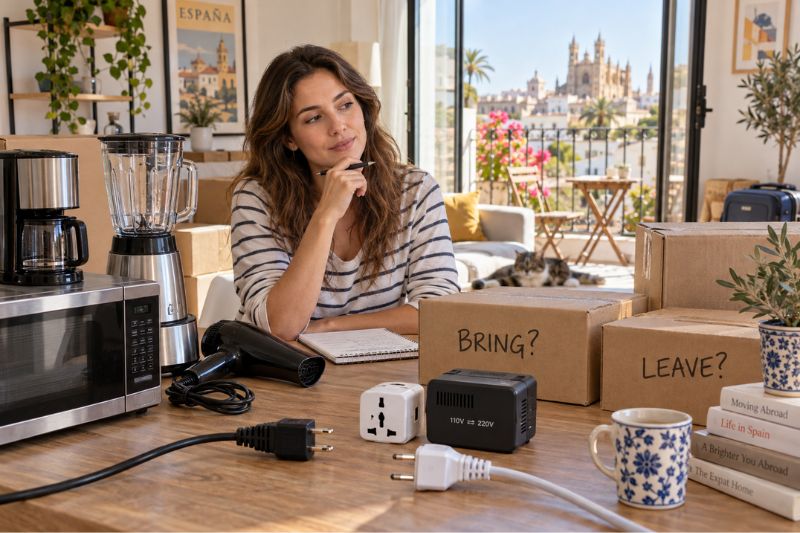
Getting your belongings from the U.S. to Madrid involves international ocean freight and final-mile logistics within Spain. Madrid is an inland city, which means your shipment doesn’t arrive at a Spanish port and walk to your apartment. It takes time, coordination, and a mover who understands the Spanish side of the delivery as well as the American departure.
Most household moves from the U.S. to Spain travel by sea freight shipping to Spain. For larger moves, a full container is the most cost-effective option. For smaller moves, groupage shipping, where your goods share container space with other shipments, keeps costs manageable without sacrificing the safety of a proper container move.
Air freight shipping to Spain is also available for smaller, time-sensitive shipments. It’s meaningfully faster but more expensive, and it works best for valuables or essentials you need before your main shipment arrives.
Packing and Pickup
SDC handles the full process from your U.S. address. Our team packs professionally, prepares the necessary export documentation, and coordinates the container loading and shipping. You don’t need to manage the logistics yourself.
Customs Clearance in Spain
Your shipment will go through Spanish customs before delivery. The process is manageable with the right paperwork, including your proof of residency or visa, a detailed inventory of your goods, and the appropriate customs declaration forms. SDC’s Spain-side network manages this on your behalf. For a closer look at what’s involved, our Spain customs forms guide explains exactly what you’ll need to prepare.
Delivery to Your Madrid Address
Madrid apartment buildings vary enormously. Some have elevators large enough for furniture. Many don’t. Stairwells can be narrow, turns can be tight, and permits may be required to park a moving truck on certain streets. Our local delivery team handles all of this, including coordination with your building and any necessary street permits. This is where having a mover with actual on-the-ground experience in Spanish cities makes a real difference.
If you’re not moving into your permanent address immediately, we offer secure storage in Spain while you get settled.
Practical Things to Sort Before You Leave
Beyond the visa and the shipping, there are several practical matters worth getting ahead of before your departure date.
Open a Spanish bank account. Most Spanish landlords require a Spanish bank account to set up a rental, and having one makes everything from utility payments to grocery shopping easier. Several banks offer non-resident accounts that you can open before you arrive.
Sort out your phone situation. Getting a Spanish SIM card is usually more cost-effective for day-to-day use than relying on a U.S. international plan. The main Spanish carriers, including Movistar, Vodafone, and Orange, all offer competitive prepaid and contract options.
Register at your local town hall (Padrón municipal). Registering as a resident with your city hall is a requirement for accessing public services including healthcare. It’s also needed for several other bureaucratic processes. Do it as soon as you’re settled in your new address.
Get your documents translated and apostilled. Any official U.S. documents you’ll need in Spain, including birth certificates, marriage certificates, diplomas, or driving records, may need to be officially translated into Spanish by a certified translator and apostilled by the relevant U.S. authority. Getting this done before you leave saves significant time.
Learn some Spanish before you go. Madrid is more English-friendly than many European capitals, but everyday life, bureaucracy, and integration are all considerably easier if you arrive with some Spanish ability. Even a few months of consistent practice before your move pays dividends on the other side.
What the First Few Months in Madrid Actually Feel Like
There is a version of arriving in Madrid that people describe as overwhelming. The bureaucracy is real. Finding housing from abroad is genuinely difficult. The pace of daily life is different from what most Americans are used to, and some of those differences take adjustment.
There’s also a version that people describe as one of the best things they ever did. Madrid rewards the people who lean into it rather than expecting it to meet them where they are. The neighborhoods, the food culture, the social ease of a city where people genuinely like being outside and together, all of it adds up to something that many American expats say they couldn’t imagine leaving.
The expat community in Madrid is substantial and welcoming. There are meetup groups, international social networks, English-language services, and a large community of people who have made exactly this transition and are happy to share what they know.
The logistics get sorted. The bureaucracy eventually gets done. And then one afternoon, sitting at a table outside a bar in your neighborhood, watching the city go by, it starts to feel less like a destination and more like where you live.
Ready to Start Planning Your Move to Madrid?
When you imagine your life in Madrid, the late dinners and the Sunday markets and the feeling of a city that is always, somehow, completely alive, that future is closer than it probably feels right now. The logistics are real, but they’re manageable, and you don’t have to figure them out alone.
At SDC International Shipping, we’ve helped hundreds of Americans make this exact move. We handle the packing, the shipping, the customs, and the delivery, so you can focus on the life you’re building.
Call (844) 651-7050 to speak with a relocation specialist, or visit Get a Quote to begin planning your move to Madrid today.