When You’re Moving to Spain Alone, but the Move Isn’t
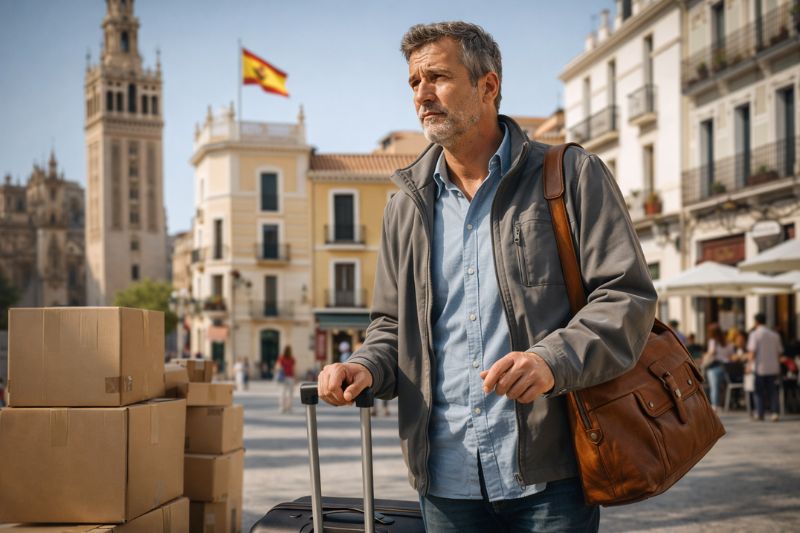
For many people, the move to Spain begins as a solo journey, even if it won’t stay that way forever.
A partner follows later.
Family arrives once housing is settled.
Belongings trail behind on a different timeline.
On paper, this looks manageable. Emotionally, it can feel heavy.
Arriving alone means you become the single point of contact for everything. You’re adjusting to a new country, handling daily life, and carrying responsibility for decisions that affect more than just you. At the same time, your household goods are still in motion, or not yet in Spain at all.
This combination often catches people off guard.
It’s not that the logistics are impossible. It’s that everything funnels through one person at once. There’s no one to share the mental load with in the moment. Questions feel bigger. Decisions feel lonelier.
Many people quietly wonder if they’ve taken on too much.
The truth is that solo arrivals are extremely common in international moves to Spain. They happen foron purpose and out of necessity. What matters is not whether you’re arriving alone, but whether the move is designed to support you during that phase.
When planning assumes a single person managing arrival, communication, and coordination, the experience feels contained. When it doesn’t, even small uncertainties can feel overwhelming.
If you’re still grounding yourself in how international relocations to Spain are typically structured, this overview helps frame how solo arrivals fit naturally into phased and flexible moves:
https://www.movertospain.com/international-moving-to-spain/
Why Solo Arrivals Often Feel Harder Than Expected
Most people anticipate logistical challenges. Fewer anticipate emotional compression.
When you arrive alone, everything happens in a smaller circle. There’s no built-in pause to talk things through. No shared processing. You are simultaneously the decision-maker, the point of contact, and the person adapting to a new environment.
That concentration of responsibility is what makes this phase feel intense.
It’s also temporary.
What often helps is understanding that you are not meant to carry the entire move by yourself, even if you are physically the only one there. Professional international moves are designed to distribute responsibility through systems, documentation, and communication, not through constant personal oversight.
When that support structure is in place, being alone does not mean being unsupported.
Another reason solo arrivals feel difficult is that people assume they must handle everything immediately. Housing, delivery timing, storage decisions, paperwork. In reality, many of these decisions can wait. Others can be handled with guidance rather than guesswork.
The most stressful solo moves are not the ones where someone arrives alone. They are the ones where the plan assumes two people will be present, but only one is.
When the move is designed with solo arrival in mind, expectations change. Communication becomes clearer. Decisions are paced. The experience becomes steadier.
If you’re in this situation now, feeling stretched does not mean you’ve misjudged the move. It usually means you’re in the narrowest part of the transition, where responsibility is concentrated before it spreads back out again.
How the Move Is Managed When You’re the Only One There
When you arrive in Spain alone, one of the biggest reliefs is realizing that you are not expected to personally manage every moving part.
Professional international moves are not designed to rely on constant, in-person supervision. They are designed to function through coordination, documentation, and clear points of responsibility. When the move is planned with solo arrival in mind, the workload does not land on you all at once.
Delivery decisions, for example, do not need to be made immediately. If your shipment arrives before you’re ready, storage acts as a buffer. You don’t need to accept delivery just because something is available. Timing can be aligned with your capacity, not just the calendar.
Customs coordination also does not require you to physically manage the process. Documentation and communication handle that phase. Your role is to stay informed and reachable, not to personally navigate every step.
This is especially important for solo movers, because emotional bandwidth matters. Adjusting to a new country uses more energy than most people expect. When the move absorbs pressure instead of adding to it, you’re able to focus on settling in rather than constantly reacting.
The key is that the plan assumes you are one person, not half of a team that hasn’t arrived yet. When expectations match reality, the experience feels far more manageable.
The Pressure Solo Movers Put on Themselves
One of the most common patterns among solo movers is self-imposed urgency.
People feel they need to be hyper-competent. To prove they can handle it. To make quick decisions so nothing “falls behind.” That pressure often comes from the belief that being alone means there’s no margin for error.
In reality, margin is built into the move, or it should be.
Rushing delivery decisions, forcing housing choices, or trying to solve everything in the first few weeks often creates more stress than it prevents. Solo movers sometimes confuse responsibility with immediacy.
Responsibility is about stewardship.
Immediacy is about anxiety.
You can be responsible without doing everything at once.
Many decisions are better made after you’ve been in Spain long enough to feel oriented. Others can be guided by professionals rather than guessed at in isolation. Allowing that support in is not weakness. It’s good judgment.
The most stable solo moves are the ones where the mover gives themselves permission to be new. To learn. To ask questions. To let systems and people carry some of the load.
When you stop trying to manage everything personally, the move begins to feel less like a test and more like a transition.
How SDC Supports Solo Arrivals So You’re Not Carrying It Alone
At SDC International Shipping, we work with solo movers regularly, and we plan differently because of it.
We assume there is one primary point of contact. We simplify communication. We structure decisions so they can be made in stages rather than all at once. We make sure storage, insurance, and delivery options are aligned so nothing forces your hand while you’re still adjusting.
Our goal is to reduce cognitive load.
That means fewer urgent decisions.
Clear next steps.
Support that doesn’t depend on you being everywhere at once.
When partners or family arrive later, the move naturally expands. Until then, the plan holds steady without requiring constant attention.
Solo arrival is a phase, not the whole story. When the move is designed with that in mind, it feels contained instead of overwhelming.
Solo Arrival Is a Phase, Not a Verdict
One of the most helpful ways to reframe this experience is to recognize that arriving alone concentrates responsibility temporarily. It doesn’t mean the entire move rests on your shoulders forever.
For a short period, you are the decision-maker, the communicator, and the person adapting to a new environment. That concentration can feel intense, but it also passes. As shipments arrive, partners join you, routines form, and support systems expand, responsibility redistributes naturally.
Nothing about arriving alone means you’re meant to solve everything immediately.
You are allowed to pause.
You are allowed to defer decisions.
You are allowed to let parts of the move remain in motion without your constant attention.
When people accept solo arrival as a stage, rather than a test, anxiety tends to ease. The move feels less like a burden and more like a sequence that will eventually balance out.
This perspective also helps with self-compassion. Feeling stretched during this phase is normal. It does not mean you are struggling. It means you are in the narrowest part of a larger transition.
You Don’t Have to Do This by Yourself, Even If You’re Alone
The most important reassurance for solo movers is this: being physically alone does not mean being unsupported.
A well-structured international move anticipates that one person may carry communication for a while. When that reality is built into the plan, you are not left improvising. You are guided.
If you’re navigating arrival in Spain while your belongings or loved ones are still on their way, the goal is not to prove you can handle everything. The goal is to let the move work as designed, absorbing pressure so you don’t have to.
If you want to talk through how your move can stay manageable while you’re the only one on the ground, having that conversation early can make the difference between feeling overwhelmed and feeling steady.
Call (844) 651-7050 to speak with a relocation specialist or visit https://www.movertospain.com/get-a-quote/ to start planning your move.