For a certain kind of American, the appeal of Spain is not just lifestyle. It is logistics. You already work remotely. Your income follows you. The question is not whether you can afford to live in Spain, it is whether you can make the move work in a way that fits how you actually live.
That is a very different question than the one most relocation content tries to answer. Most guides assume you are uprooting a full household, signing a long-term lease, and committing to one city before you board the plane. Digital nomads rarely work that way. Your move is likely smaller, more flexible, and more deliberate than a traditional relocation. And yet the logistics still matter, because even a lean move involves shipping decisions, customs requirements, visa paperwork, and a plan for what happens to your belongings while you figure out where you want to land.
If you are thinking about relocating from the U.S. to Spain as a remote worker, this guide is written for you. Not for the retiree, not for the family with four bedrooms to ship, but for the person who wants to move thoughtfully, with the right visa, the right shipping plan, and a realistic picture of what the first chapter in Spain actually looks like.
What the Digital Nomad Visa Actually Is (and Who It’s For)
Spain launched its digital nomad visa in 2023 as part of the Startup Act, and it has since become one of the most talked-about options for American remote workers looking to establish legal residency in Europe. The visa allows you to live in Spain while working remotely for a company or clients based outside of Spain.
That last part matters. This visa is specifically designed for people whose income comes from outside Spain. If you work for a U.S. employer, run a U.S.-based freelance business, or have international clients, you are likely a strong candidate. If you are planning to find work locally in Spain once you arrive, this is not the right path.
Income Requirements
Spain requires applicants to demonstrate sufficient income to support themselves without relying on local employment. The threshold is tied to Spain’s minimum interprofessional wage, and most applicants need to show monthly income comfortably above that baseline. If you have additional family members joining you, the income requirement increases accordingly.
The specific figures are subject to change, so it is worth confirming current thresholds with a visa specialist or through the Spanish consulate before applying. What does not change is the principle: Spain wants to see that you can support yourself financially without competing in their labor market.
Work History and Employment Documentation
If you are employed by a U.S. company, you will typically need a letter from your employer confirming your remote work arrangement, your role, and your salary. If you are self-employed or freelance, you will need to demonstrate that your business is legally established and that you have been operating for a meaningful period, generally at least three months, though longer history strengthens your application considerably.
Contract workers and consultants may need to show client agreements, invoices, and bank statements to establish income consistency.
How It Compares to the Non-Lucrative Visa
Some digital nomads with passive income, investments, or savings consider the non-lucrative visa instead. That path requires proving you can live off existing assets rather than active income, and it prohibits any work at all, including remote work for foreign clients. If you are actively earning while you live in Spain, the digital nomad visa is the appropriate route. The Spain Visa Guide covers both options in detail and can help you identify which fits your situation.
The Application Process: What to Expect and How Long It Takes
The digital nomad visa application is processed through the Spanish consulate in your jurisdiction. As an American, your consulate is determined by your state of residence, and wait times for appointments and decisions can vary considerably depending on which consulate handles your case.
Core Documents You Will Need
While requirements can evolve, most applicants need to prepare the following before applying:
A completed national visa application form, a valid U.S. passport with at least one year of validity remaining, recent passport photos meeting Spanish specifications, proof of income through employment letters or business documentation, criminal background check apostilled for international use, private health insurance that covers you in Spain without copays (a common requirement), and proof of accommodation in Spain for your initial period, such as a rental agreement or hotel reservation.
Documents issued in the United States generally need to be apostilled, and any documents in English need certified Spanish translations. Starting this process early is essential because apostilles and translations add time that many applicants underestimate.
Timeline From Application to Arrival
Consulate processing times vary, but most applicants should expect the process to take several weeks to a few months from the time of their appointment. Some consulates are faster than others, and scheduling the appointment itself can add time. Building at least three to four months of lead time into your plan is sensible, and six months is better if you want a relaxed runway.
Once you arrive in Spain, you will need to apply for your TIE, the foreigner identity card, within a certain period. You will also need to obtain your NIE number, a tax identification number required for almost every administrative task in Spain, from opening a bank account to signing a lease.
How a Nomad Move Is Different From a Traditional Relocation
Most international moving content is written with a full household in mind. Four bedrooms, two cars, a garage, a kitchen full of appliances. That is not most digital nomads.
But smaller does not mean simpler. A nomad move has its own set of decisions that traditional relocation guides do not address.
You May Not Know Where You Are Landing Yet
Many digital nomads arrive in Spain before committing to a permanent city. You know you want to be in Spain, but whether that means Valencia or Seville or a smaller coastal town is something you want to experience before deciding. This uncertainty is completely reasonable, and it shapes how you should think about your shipment.
If you do not yet have a permanent address, shipping your belongings directly into a Spanish home is not always possible. Secure storage in Spain bridges that gap. Your items arrive in the country, clear customs, and are held safely until you are ready for delivery to your chosen address. Our secure storage in Spain service is used frequently by nomads and phased movers for exactly this reason.
Your Shipment Is Likely Smaller, and That Changes Your Options
Most digital nomads do not fill a full container. That is not a problem. Smaller shipments have their own solutions, and understanding them helps you plan efficiently.
Groupage shipping, sometimes called shared container service, allows your belongings to travel in the same container as other customers’ goods. You pay only for the space your shipment occupies rather than reserving an entire container. For nomad-sized moves, this is usually the most practical and cost-effective sea freight option. You can learn more about how this works on our groupage shipping to Spain page.
For very small or urgent shipments, air freight shipping to Spain is another option. It costs more per cubic foot, but for a minimal load of essentials, the speed may be worth it, particularly if you need specific items before your sea shipment arrives.
Timing Is More Flexible, but Still Needs to Be Planned
One advantage of a nomad move is that you are not typically locked into a specific move-in date the way a family with school enrollments or a job start date might be. That flexibility is an asset, but it can also lead to delayed planning. Sea freight takes several weeks, and customs processing adds time on top of that. Starting early still matters, even if your exact arrival window is loose.
What to Ship, What to Store, and What to Leave Behind
One of the most useful exercises before a nomad move is a deliberate audit of everything you own. Not a rushed sort before the movers arrive, but an honest assessment of what you actually need in Spain, what you might want later, and what no longer needs to follow you.
Ship: What Belongs in Your Shipment
Personal items with genuine sentimental value, your work setup, quality clothing suited to a Mediterranean climate, books and personal collections, a few key pieces of furniture if you have a specific permanent address in mind, and anything that would be costly or difficult to replace in Spain. Your professional gear, monitors, external drives, standing desk, quality headphones, the items that make your remote work function well, are worth shipping because replacing them abroad adds expense and disruption.
Store: What to Hold in the U.S. While You Settle
If you are not selling your U.S. home or if you are uncertain how permanent your Spain chapter will be, a storage unit in the States gives you a safety net. Furniture that would not fit a Spanish apartment, seasonal items, family heirlooms, and backup belongings you do not need immediately are all reasonable candidates for U.S. storage during your first year abroad.
Leave: What Does Not Make the Trip
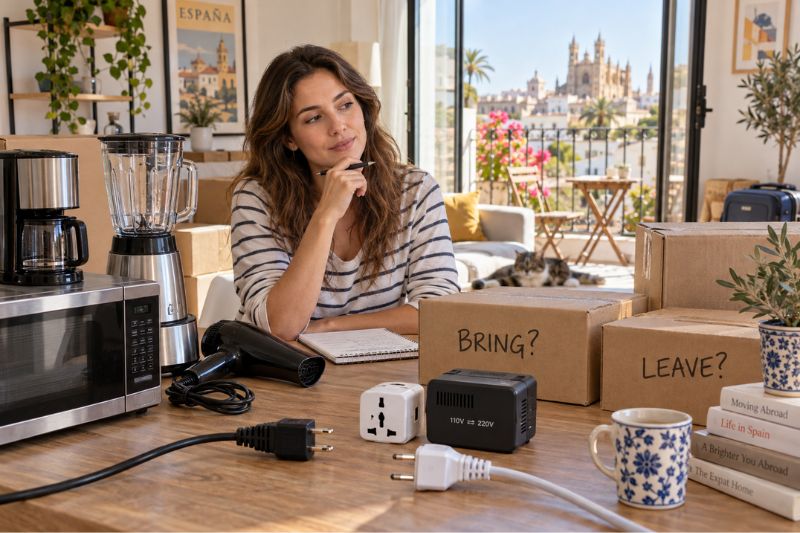
Oversized American furniture rarely fits Spanish apartments, especially in older city buildings with narrow stairwells and compact elevators. U.S. appliances generally do not work on Spain’s 220-volt system without converters, and even with converters, long-term reliability suffers. Most kitchen appliances, small electronics, and generic home goods are better replaced locally. Spain has strong retail options, and starting fresh with some items is often more practical than shipping things that will cause problems on arrival.
Our household goods shipping to Spain page covers what typically travels well and what tends to create complications at customs or delivery.
Choosing Your First Base in Spain
Spain is not one experience. It is a collection of distinct cities and regions, each with its own rhythm, cost structure, community, and climate. For digital nomads, the right base depends as much on how you work as on how you want to live.
Valencia
Valencia is consistently popular among American remote workers. The cost of living is lower than Barcelona or Madrid, the weather is reliably good, the city is walkable and bikeable, and the expat community is large enough to ease the transition without overwhelming the local character. It has a growing co-working scene and strong internet infrastructure, which matters when your income depends on connectivity.
Malaga
Malaga has become one of Europe’s most prominent digital nomad hubs. The city has invested in tech infrastructure, co-working spaces are abundant, and the cost of living remains reasonable by Spanish standards. The Costa del Sol climate means more sun than almost anywhere else in Western Europe. It attracts a younger international crowd and has a noticeable energy around remote work culture.
Barcelona and Madrid
Both cities offer world-class infrastructure, international communities, and professional networks. They are also more expensive. For nomads whose income is strong and who want the full metropolitan experience, either city works well. For those trying to maximize quality of life against cost, the secondary cities often win.
Seville, Granada, and Smaller Cities
These cities offer lower costs, strong cultural character, and a pace that many remote workers find deeply conducive to focused work. The tradeoff is a smaller expat community and occasionally less developed co-working infrastructure, though that gap is narrowing. Nomads who have already spent time in Spain’s larger cities often find that a secondary city suits them better once they know what they are looking for.
Practical Setup After You Arrive
The first weeks in Spain involve a set of administrative tasks that every resident, nomad or otherwise, needs to work through. Getting these done early makes everything else easier.
NIE Number
The NIE, or Número de Identificación de Extranjero, is your tax identification number in Spain. You need it for almost everything: opening a bank account, signing a lease, registering with local authorities, and eventually filing taxes if you become a tax resident. You can apply for your NIE at a Spanish police station after arrival or, in some cases, through the Spanish consulate before you leave the U.S. Getting this sorted early removes a bottleneck that delays nearly every other administrative task.
Empadronamiento
Once you have a fixed address, you will need to register with your local municipality through a process called empadronamiento. This registration is required for accessing many local services and is often needed to support other applications, including your TIE. It requires proof of your address, typically a signed lease or a letter from your landlord.
Banking
Opening a Spanish bank account requires your NIE, passport, proof of address, and sometimes employment documentation. Some banks are more foreigner-friendly than others. Online banks and fintech options have also made it easier for nomads to manage money across currencies in the short term, though a local account is eventually useful for rent payments and utilities.
Health Insurance
Your digital nomad visa requires private health insurance that covers you in Spain, typically without copays. Once you become a resident and begin contributing to Spain’s social security system, you may eventually access the public health system. In the meantime, private insurance is both a legal requirement and a practical necessity.
How SDC Supports Digital Nomad Moves
SDC International Shipping works with a wide range of Americans relocating to Spain, from full-household family moves to compact nomad shipments. The size of your move does not determine the quality of support you receive. What changes is the shipping method and the plan, not the level of care.
For digital nomads, the most common approach is a groupage shipment for personal goods and work essentials, combined with secure storage in Spain if the final delivery address is not yet confirmed. Some nomads also choose a phased approach, shipping a small air freight load first and following up with a sea shipment once they have settled on a city and signed a lease.
Our team helps you think through the sequence before anything is packed. Which items need to arrive first. Whether storage makes sense for your timeline. How customs documentation needs to be prepared given your visa status. These are not complicated questions when you have someone who knows the process walking alongside you.
For a full picture of how international moving to Spain works, including what SDC coordinates from the U.S. side and what happens on delivery in Spain, that page covers the full sequence.
Ready to Build Your Remote Life in Spain?
The digital nomad visa has made Spain genuinely accessible for Americans who work remotely, and the move itself is more manageable than most people assume. What it requires is the right information, a realistic plan, and a shipping partner who understands that your move may not look like anyone else’s.
You do not have to fill a container to make this work. You do not have to have every detail figured out before you begin. You just need a clear next step and someone who has helped people like you make this exact transition.
Call (844) 651-7050 to talk through your move with a relocation specialist, or visit Get a Quote to start building your plan.