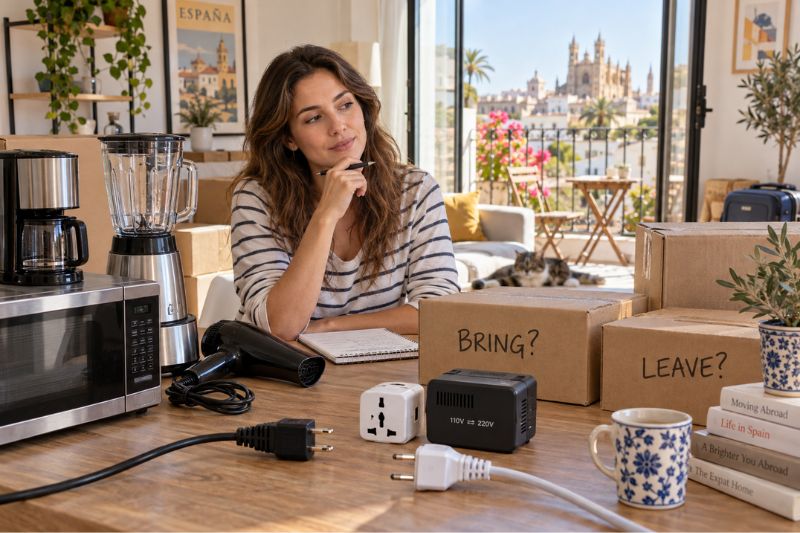
There is a moment in many international moves when people feel confused by their own reaction.
The plan is solid.
The mover is booked.
Paperwork is underway.
Nothing has fallen apart.
And yet, instead of feeling calm or excited, you feel overwhelmed.
This can be deeply unsettling. People often expect stress when something goes wrong, but when everything is technically on track, feeling anxious or drained can feel like a personal failure. Some start to wonder if they misjudged the move itself.
That reaction is far more common than most people realize.
International moves to Spain involve an unusual kind of pressure. Not the urgent, visible pressure of a crisis, but the quieter pressure of constant decision-making, uncertainty, and emotional load, all layered on top of everyday life.
Even when logistics are handled well, your nervous system may still be catching up.
Many people are surprised to discover that the most emotionally intense phase of a move is not when things break down, but when they are progressing steadily. The mind finally has space to process the magnitude of what’s happening.
Nothing is “wrong.”
You are not behind.
You are not failing at the move.
You are experiencing a normal response to a major life transition.
If you’re still orienting yourself to the overall structure of an international relocation, this overview helps ground the process and remind you how many moving parts are already being handled professionally:
https://www.movertospain.com/international-moving-to-spain/
Why Good Planning Doesn’t Automatically Reduce Emotional Load
One of the most persistent myths about moving abroad is that good planning equals peace of mind.
In reality, good planning reduces risk, not emotion.
Planning handles logistics.
Emotion responds to change.
Even the best-planned move requires you to sit with unanswered questions. How life will feel. Who you’ll be once you arrive. What you’ll miss. What you might gain. These questions don’t resolve themselves just because boxes are packed and timelines exist.
Another factor people underestimate is decision fatigue.
International moves require hundreds of small decisions layered over weeks or months. What to ship. What to leave. When to arrive. Where to stay. What can wait. Even when each decision is reasonable, the accumulation can be exhausting.
This fatigue often shows up as irritability, second-guessing, or a vague sense that everything feels heavier than it should.
There is also the emotional weight of liminality, being between versions of your life. You may no longer feel fully anchored in the U.S., but you’re not yet settled in Spain. That in-between space can feel unsteady, even when the path forward is clear.
None of this means your plan is flawed.
It means your experience is human.
Understanding this distinction is important, because when people misinterpret overwhelm as a sign of failure, they often create additional stress by trying to “fix” something that isn’t broken.
The move doesn’t need to be calmer.
You need to be supported while it unfolds.
The Emotional Myths That Make Moving Feel Harder Than It Needs to Be
When a move feels overwhelming despite careful planning, people often turn inward and start telling themselves unhelpful stories.
One common myth is “If this were the right decision, it would feel calm.”
In reality, meaningful decisions rarely feel calm while they’re unfolding. They feel calm in hindsight. During the transition, uncertainty is unavoidable, even when the direction is right.
Another myth is “Everyone else seems to be handling this better than I am.”
Most people don’t talk openly about the emotional strain of moving abroad. What you see publicly is competence, not the private processing underneath it. Feeling stretched does not mean you’re doing something wrong. It means you’re carrying a lot.
There’s also the belief that overwhelm means something needs fixing. People start searching for errors in the plan, questioning timing, or second-guessing choices that were made thoughtfully. This often adds stress instead of relieving it.
Overwhelm is not a diagnostic tool.
It’s a signal that your system is adjusting.
When these myths go unchallenged, people try to push through emotions instead of accommodating them. The result is fatigue, not clarity.
Understanding that emotional strain can exist alongside good planning is often the moment people stop fighting their own experience.
How Experienced Movers Plan Around Emotional Strain, Not Just Logistics
Seasoned international movers know something that first-time movers often don’t. The hardest part of a relocation is rarely the shipping. It’s the human bandwidth.
This is why experienced planning doesn’t just focus on efficiency. It focuses on containment.
Containment means:
- Decisions are staged rather than stacked
- Flexibility is built in so nothing feels urgent by default
- Storage exists so timing mismatches don’t become crises
- Communication is predictable instead of reactive
These structures don’t just protect belongings. They protect people.
When movers anticipate that clients will feel stretched, plans are designed to absorb pressure quietly. Fewer forced decisions. More breathing room. Clear next steps instead of open-ended demands.
This is also why “nothing going wrong” can still feel intense. The systems are doing their job, which means you’re left to experience the emotional side of a major life change without constant distraction.
That is not a failure of planning. It is often a sign that planning is working.
The goal of a good move is not to eliminate feeling. It’s to ensure feeling doesn’t derail the process.
How SDC Supports Clients When the Move Feels Heavy
At SDC International Shipping, we understand that clients don’t just move households. They move lives.
When someone feels overwhelmed, even though the move is on track, the response is not to push faster or tighten timelines. It’s to steady the experience.
That may mean slowing decision cadence.
Clarifying what can wait.
Reassuring clients that flexibility is already built in.
Confirming that nothing urgent is being missed.
Often, a single grounded conversation reduces more stress than any logistical change.
Our role is not just to coordinate shipping and customs. It’s to hold the structure of the move so clients don’t have to carry it all mentally. When people know that someone experienced is watching the whole picture, the emotional load lightens naturally.
Feeling overwhelmed is not a signal to rush or reconsider. It’s a signal to let the systems support you.
When Overwhelm Is Part of the Transition, Not a Warning Sign
One of the most important realizations people come to during an international move is this:
overwhelm is not a signal that something is wrong.
It is a signal that something significant is happening.
Moves to Spain often involve identity shifts, lifestyle changes, and long-term uncertainty layered on top of logistics. Even when those logistics are handled well, the emotional system still needs time to adjust. Feeling stretched does not mean you made a bad decision. It means you are crossing a meaningful threshold.
Many people expect reassurance to come from certainty. In reality, reassurance often comes from continuity. Knowing that the process is moving forward, that flexibility exists, and that nothing urgent is being overlooked allows emotions to settle naturally over time.
Overwhelm usually peaks when:
- Most major decisions have been made
- The old life is winding down
- The new life hasn’t fully started yet
That in-between phase is uncomfortable by nature. It doesn’t mean you should retreat or accelerate. It means you are exactly where most people find themselves during a well-planned move.
Once arrival happens and routines begin to form, this intensity almost always softens. The questions that felt heavy start answering themselves through experience rather than thought.
A Move Can Be Successful Even If It Doesn’t Feel Calm
There is no rule that says a successful move must feel peaceful while it’s happening.
Some of the most successful relocations to Spain are remembered not for how easy they felt at the time, but for how supported people felt once they were through them. Calm is often an outcome, not a prerequisite.
If you’re feeling overwhelmed right now, it does not mean you’re missing something. It means you’re in the part of the journey where emotions surface because logistics are no longer demanding all your attention.
That’s not a flaw in the plan. It’s a human response to transition.
The most important thing is that you don’t interpret emotional strain as a reason to rush, second-guess, or carry more than you need to. This is the moment to lean into structure, not override it.
If you need reassurance that your move is progressing as it should, or simply want to talk through what can wait and what doesn’t matter as much as it feels like it does, that conversation can make all the difference.
Call (844) 651-7050 to speak with a relocation specialist or visit https://www.movertospain.com/get-a-quote/ to start planning your move.