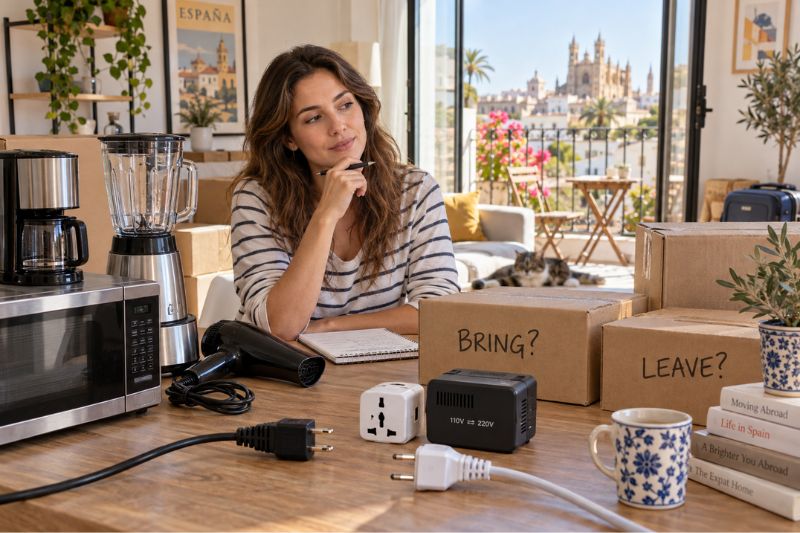
The Quiet Fear Most People Don’t Say Out Loud
There’s a moment that comes for many people after they’ve made their shipping decisions.
The shipment is booked.
The boxes are packed, or left behind.
The choices are locked in.
And then the questions creep in.
What if I shipped too much?
What if I didn’t ship enough?
What if I realize, six months from now, that I made the wrong calls?
This fear rarely shows up during the planning phase, when everything feels theoretical. It appears later, once decisions become real and irreversible. That’s why it can feel unsettling. You’re no longer choosing, you’re living with the consequences of choices you made without full information.
Almost no one talks about this openly.
People assume regret means they planned poorly, or that experienced movers somehow avoid it entirely. In reality, regret is not a sign of a bad move. It’s a natural byproduct of making decisions before you have lived the outcome.
Moves to Spain require judgment calls made from a distance. You choose what to bring based on floor plans you haven’t lived in, routines you haven’t established, and a lifestyle you haven’t fully experienced yet. There is no way to get every decision perfectly right.
That doesn’t mean the move was a mistake.
It means the move was human.
If you’re still orienting yourself to how international moves to Spain are structured and why so many decisions happen earlier than comfort would prefer, this overview helps ground the process in reality rather than perfection:
https://www.movertospain.com/international-moving-to-spain/
Why Regret Is Almost Impossible to Avoid, and Why That’s Okay
One of the biggest misconceptions about international relocation is that the “right” amount to ship is something you can calculate in advance.
In practice, regret doesn’t come from doing something wrong. It comes from learning something new.
You learn that your Spanish home functions differently.
You learn that daily life requires less, or sometimes more, than you expected.
You learn which objects mattered emotionally and which ones mattered only out of habit.
That learning happens after arrival, not before.
People who ship everything often regret the excess. Storage they don’t need. Furniture that doesn’t fit the space or lifestyle. Items that felt essential in the U.S. but feel irrelevant in Spain.
People who ship less often regret the absence of specific things. A chair that was more comfortable than they realized. Kitchen items they used daily. Sentimental objects that grounded them emotionally more than expected.
Both forms of regret come from the same place. You couldn’t know yet.
The problem is not regret itself. The problem is when people interpret regret as proof that they failed at planning. That belief creates unnecessary anxiety and self-blame.
In reality, the goal of a good move is not to eliminate regret. It’s to limit the consequences of regret.
That’s why experienced movers think in terms of reversibility, flexibility, and phased decisions. Not because people are indecisive, but because they are honest about how understanding evolves over time.
Regret doesn’t mean you chose poorly.
It means you’ve gained clarity.
And clarity, even when it comes with a little discomfort, is what allows the move to settle into something that actually fits.
The Most Common Regrets People Experience After Arrival
Regret rarely shows up as a dramatic realization. It usually appears quietly, in ordinary moments.
You reach for something that isn’t there.
You notice an item taking up space without adding value.
You feel a small pang and move on.
Over time, patterns emerge.
One common regret is bringing items tied to space rather than use. Furniture that worked well in a larger U.S. home can feel intrusive in a Spanish apartment. People often realize they shipped pieces out of habit, not because they truly supported daily life.
Another regret involves underestimating emotional anchors. Objects that seemed replaceable sometimes turn out to matter more than expected. Not because they’re necessary, but because they provide continuity during a period of change.
There is also regret around timing rather than content. People wish they had delayed certain decisions, not because the items were wrong, but because they would have preferred to decide with lived experience rather than imagination.
What’s important to understand is that these regrets are usually mild, not catastrophic. They don’t derail the move. They simply reveal preferences that weren’t fully formed yet.
Most people also discover that regret shifts over time. What feels like a mistake in the first month often becomes irrelevant by the sixth. Life in Spain fills gaps faster than expected. New routines replace old dependencies.
Regret tends to shrink as belonging grows.
Why Regret Rarely Lasts as Long as You Think It Will
When people worry about regret before a move, they imagine it lingering indefinitely.
In reality, regret around belongings is usually temporary because it’s tied to transition, not outcome.
During the early weeks in Spain, you’re more aware of what’s missing or out of place because everything is new. Once routines stabilize, those absences or excesses stop standing out.
You adapt.
You substitute.
You reprioritize.
Spain itself accelerates this process. Daily life shifts outward. Storage becomes intentional. Convenience replaces accumulation. People often find that what mattered deeply in the U.S. becomes peripheral once their environment changes.
Even when regret does persist, it’s rarely absolute. People don’t think, “I ruined this move.” They think, “Next time, I’d do this differently.” That’s learning, not failure.
And for many decisions, there is still room to adjust. Items can be shipped later. Items can be stored, sold, or rehomed. Very few choices are as final as they feel in the moment.
The fear of regret is usually larger than the regret itself.
How SDC Plans Moves to Absorb Regret Without Penalty
At SDC International Shipping, we don’t assume clients will get every decision “right” the first time.
We assume decisions will evolve.
That assumption changes how moves are planned. Shipping is structured with flexibility. Storage is positioned as a tool, not a fallback. Insurance coverage is aligned with multiple phases, not a single, perfect outcome.
This means that when clients later wish they had done something differently, the system can respond without panic.
If you decide you want additional items shipped later, that option exists.
If you realize certain items don’t belong in your new space, storage provides time to decide calmly.
If priorities change, plans can adjust without starting over.
Our role is not to eliminate regret. It’s to make sure regret doesn’t turn into disruption.
When people know that adjustments are possible, regret loses much of its power. Decisions feel less loaded because they’re not treated as irreversible judgments on the future.
Regret Is Information, Not Evidence You Did It Wrong
One of the healthiest shifts people make after arriving in Spain is changing how they interpret regret.
Regret does not mean you misjudged the move.
It does not mean you lacked discipline or foresight.
It does not mean you should have waited longer or done more research.
Regret usually means you now have better information than you did before.
Before the move, decisions are abstract. After arrival, they’re contextual. You finally know how your space functions, how your days unfold, and what supports you emotionally. That clarity only exists because you moved.
Seen this way, regret becomes a normal part of settling in. It’s the moment when hypothetical choices turn into lived preferences. People who allow themselves to learn from that moment tend to feel calmer and more grounded than those who try to eliminate regret entirely.
There is also a practical truth that helps soften the fear. Very few shipping decisions are truly final. What feels irreversible in planning often turns out to be adjustable in practice. Timing can change. Storage can create space. Additional shipments can happen later if they make sense.
When the move is designed with flexibility, regret loses its sting. It becomes a note for the future, not a verdict on the past.
Trusting the Process, Even When You’d Choose Differently Now
Almost everyone who moves to Spain looks back and thinks, “I’d do a few things differently.”
That thought doesn’t mean the move failed. It means the move worked.
You learned what matters to you in this place. You learned what fits your routines, your space, and your sense of home. That learning is the whole point of relocation, not something to avoid.
People who struggle most with regret are often those who believe they were supposed to get everything right the first time. People who settle in more smoothly tend to accept that understanding arrives in stages.
If you’re worried about regret now, it often helps to ask a different question. Not “What if I regret this?” but “If I do, will I be able to adjust?”
When the answer is yes, the fear softens.
That’s why it’s so important to work with movers who plan for real life, not perfect foresight. Storage options, flexible delivery, and the ability to make changes later exist to support human decision-making, not to correct mistakes.
If you want to talk through how flexibility can be built into your move so future adjustments feel manageable, not stressful, that conversation is worth having early.
Call (844) 651-7050 to speak with a relocation specialist or visit
https://www.movertospain.com/get-a-quote/ to start planning your move.