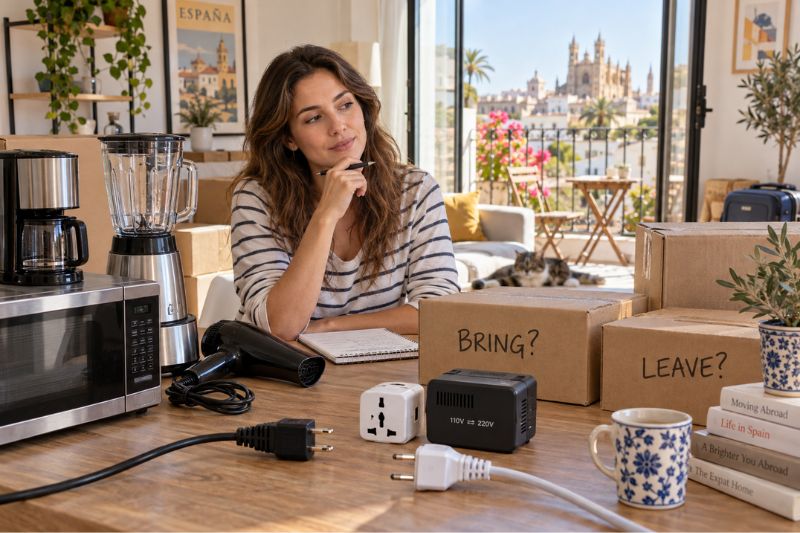
Deciding Whether to Bring Everything to Spain, or Just What You Need First
One of the quietest but most emotionally loaded decisions in an international move is not about visas or shipping methods. It is the question most people hesitate to say out loud:
Do we really need to bring everything with us right away?
For many Americans moving to Spain, this question surfaces after the initial excitement fades and reality sets in. Closets are fuller than expected. Furniture carries memories, but also weight, literally and emotionally. At the same time, Spain represents a new chapter, often smaller living spaces, different routines, and a lifestyle that does not always mirror life in the U.S.
This tension is not about indecision. It is about transition.
Some people feel comforted by the idea of arriving with everything familiar. Others feel overwhelmed by it. Many feel both at once. What complicates the decision is the assumption that an international move must be a single, all-or-nothing event. Either you ship your entire household in one go, or you are somehow delaying the “real” move.
In practice, that assumption does not hold up.
Moves to Spain increasingly happen in phases. Not because people are unsure about the move itself, but because they are thoughtful about how they want to arrive, live, and settle. Phased moves allow people to test daily life, housing size, storage needs, and emotional attachment to belongings without forcing irreversible decisions before they have context.
This is especially common for retirees, families with adult children, and professionals relocating without a long-term housing contract already secured. The move is real, but the shape of life in Spain is still coming into focus.
Understanding that there is no single “correct” way to ship your household is often the moment people feel their shoulders drop. The question shifts from what am I supposed to do to what actually makes sense for us.
If you are still grounding yourself in how international relocations to Spain are typically structured, this overview can help frame the bigger picture before narrowing into phased decisions:
https://www.movertospain.com/international-moving-to-spain/
How Experienced Movers Think About Full Moves vs Phased Moves
From a professional perspective, the decision to ship everything at once or move in phases is not about commitment. It is about risk management and flexibility.
A full household move assumes several things at the same time. It assumes that your housing in Spain is permanent, that the size and layout suit your lifestyle, that your furniture fits both physically and emotionally, and that you are ready to re-create your U.S. household immediately. For some people, all of that is true. For others, it is unknowable until they have lived there.
Phased moves, by contrast, assume uncertainty and plan around it.
Experienced international movers see phased shipping not as hesitation, but as a deliberate strategy. It allows clients to separate the emotional act of moving countries from the logistical act of relocating possessions. Essentials come first. Secondary items follow only if and when they are truly wanted.
This approach also reduces pressure during the early weeks in Spain. Instead of unpacking an entire household while navigating bureaucracy, neighborhoods, and routines, people can focus on settling in. Daily life begins sooner because it is simpler.
There is also a psychological benefit. Arriving lighter gives people permission to adapt. Some discover they need far less than expected. Others confirm that certain pieces matter deeply and are worth bringing over later. Either outcome feels intentional rather than reactive.
From a logistics standpoint, phased moves are not complicated when planned correctly. Customs documentation, insurance coverage, and shipping coordination are handled with the expectation that more than one shipment may occur. The key is that this is discussed upfront, not added as an afterthought.
This is also where storage plays an important role, both in the U.S. and in Spain. Storage is not a sign of indecision. It is a buffer that protects choices while life catches up with plans.
For readers already familiar with shared container shipping, phased moves often align naturally with groupage options, which are designed for flexibility rather than speed. If you want to revisit that concept at a high level without diving into mechanics, this overview provides useful context:
https://www.movertospain.com/groupage-shipping-to-spain/
Ultimately, experienced movers do not ask whether you are shipping everything or not. They ask why you are choosing one approach over the other. When the reasoning is clear, the logistics follow.
Living in Spain Before Deciding What Else to Ship
For many people, the most useful clarity comes after arrival, not before departure.
Living in Spain changes how you relate to space, routine, and possessions. Apartments are often smaller. Storage is more intentional. Daily life happens outside the home more than it may have in the U.S. Cafés, plazas, and neighborhoods become extensions of your living space. What once felt essential can start to feel optional.
This is why phased moves often feel validating rather than limiting.
Arriving with the essentials allows you to experience Spain as it is, not as an extension of your former life. You learn what fits, what doesn’t, and what you actually miss. Some people realize quickly that certain furniture or household items no longer make sense. Others feel a clear pull toward a few meaningful pieces that make the new space feel like home.
Both outcomes are healthy.
What matters is that the decision is informed by lived experience rather than speculation.
There is also a practical side to this clarity. Once you know the size, layout, and storage capacity of your Spanish home, later shipments can be planned with far greater precision. You are no longer guessing whether something will fit or feel right. You know.
This approach reduces regret. People who ship everything at once sometimes find themselves storing or selling items they no longer want, simply because the decision was made too early. Phased movers tend to ship less overall, not because they are minimizing, but because they are choosing intentionally.
From a planning perspective, this phase works best when storage, insurance, and documentation are already aligned for the possibility of additional shipments. That way, the choice to ship more later remains open without pressure.
Common Misunderstandings About Shipping in Phases
One of the biggest misconceptions is that phased moves are somehow more complicated or risky than single shipments. In reality, problems arise not from multiple shipments, but from unplanned multiple shipments.
When movers and clients assume everything must go at once, phased decisions often happen reactively. Items are added later without proper documentation, insurance adjustments, or coordination. That is when stress appears.
When phased shipping is planned intentionally, it becomes predictable.
Another misunderstanding is that customs becomes more difficult with multiple shipments. Spanish customs does not prohibit phased household moves, but documentation must be prepared correctly for each shipment. This is why early conversations matter. When customs planning accounts for more than one shipment, the process remains orderly rather than improvised.
There is also a belief that shipping later means losing momentum or commitment to the move. In practice, the opposite is often true. People who give themselves permission to settle first tend to feel more grounded and confident. Their move feels complete because their life feels stable, not because all their belongings arrived at once.
Some worry that insurance coverage becomes fragmented with phased moves. This is another area where professional coordination matters. Coverage should reflect the actual journey of your belongings, whether they move together or separately. When insurance planning mirrors reality, timing decisions stop feeling risky.
For those who want to understand how coverage adapts across different shipment phases, this overview of international moving insurance provides helpful context without getting procedural:
https://www.movertospain.com/international-moving-insurance/
The key takeaway is simple. Phased moves are not a workaround. They are a legitimate, often preferable strategy when life transitions are still unfolding.
How SDC Helps Clients Choose the Right Shipping Rhythm
At SDC International Shipping, the question is never framed as “everything now or everything later.” It is framed as what supports your transition best.
Some clients arrive knowing they want a full household move immediately. Others are clear that they want to start lighter. Many are somewhere in between. Our role is not to push a structure, but to help you understand the implications of each option so the choice feels grounded rather than rushed.
This means discussing shipping, storage, customs, and insurance together rather than as separate decisions. It also means leaving room for adjustment. Plans are designed to accommodate change without creating friction later.
When clients know they can ship more later if they want to, they often feel calmer shipping less initially. When they know their belongings are protected and options remain open, decisions feel reversible rather than final.
That emotional safety is just as important as logistical coordination.
If you are weighing these options and want to talk them through in the context of your actual situation, not a generic scenario, that conversation is often the most valuable part of planning.
How Phased Moves Shape Long-Term Settling in Spain
One of the least discussed benefits of moving in phases is how it affects your sense of permanence.
People often assume that a move feels “real” only once everything has arrived. In practice, permanence usually comes from routines, not possessions. Knowing where to shop, how your neighborhood feels at different times of day, which cafés become familiar, and how your home functions week to week does far more to anchor you than unpacking every box at once.
Phased moves support this adjustment.
By arriving with fewer belongings, you give yourself room to observe how you actually live in Spain. You notice what storage looks like in daily use. You learn whether entertaining happens at home or outside it. You understand whether your home office needs to be fully re-created or simplified. These insights shape smarter decisions about what comes next.
Many people find that their relationship with belongings changes during this period. Items once tied to identity or routine may feel less essential. Others take on new importance because they connect emotionally to continuity and comfort. Neither reaction is right or wrong. What matters is that the decision happens after experience, not before it.
This approach often leads to fewer regrets. Instead of wondering why something was shipped unnecessarily, or why something meaningful was left behind, people tend to feel aligned with what they chose to bring later. Their home in Spain reflects who they are now, not who they were when the decision was rushed.
From a logistical standpoint, later shipments are often smoother too. You are present to receive them, coordinate delivery, and integrate them thoughtfully into your space. The move feels like a continuation rather than a disruption.
Choosing Confidence Over Finality
At its core, the decision to ship everything at once or move in phases is not about logistics. It is about how much certainty you need before committing to a version of your life.
Some people feel best making one clear, definitive move. Others feel best allowing the move to unfold. Both approaches are valid. What creates stress is believing there is only one correct way to do it.
Phased moves offer confidence without forcing finality. They allow you to commit to Spain without committing to every object you own at the same time. That distinction is subtle, but powerful.
The most successful relocations are not the ones where everything arrives together. They are the ones where decisions feel considered, supported, and aligned with how life actually develops.
If you are weighing these options now, the most helpful next step is not choosing immediately. It is talking through how each option would function in your specific circumstances, including housing, timing, storage, and insurance. Once those pieces are clear, the decision tends to make itself.
Call (844) 651-7050 to speak with a relocation specialist or visit
https://www.movertospain.com/get-a-quote/ to start planning your move.