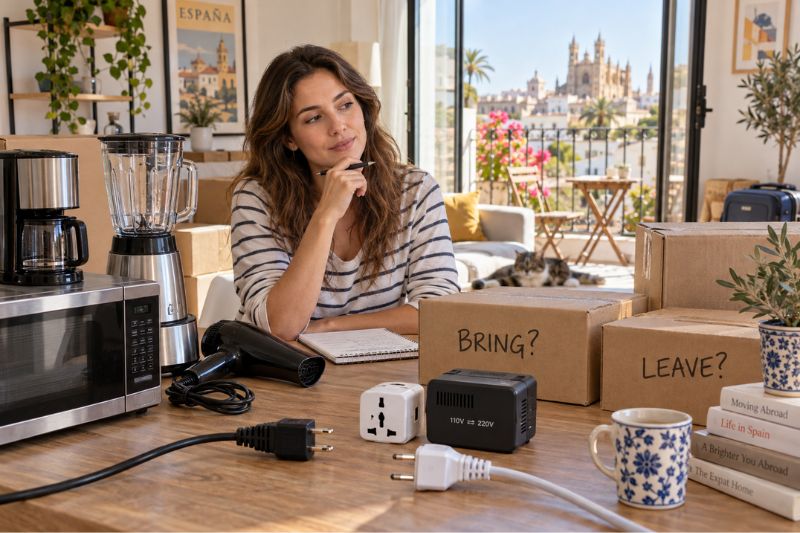
Nobody moves to Spain for the paperwork. You move for the light, the food, the slower evenings, and then you find yourself on your third trip to the same office with a fourth copy of the same document. If that sounds familiar already, you are in good company.
SDC International Shipping is a licensed FMC moving company that specializes in relocations from the USA to Spain, and Spanish bureaucracy is something every one of our clients meets. This guide lays out the registrations you will face, in the order they usually come, so you can plan for them instead of tripping over them. If you are still early in relocating from the U.S. to Spain, start here, and if your questions are about your shipment, call us at (844) 651-7050.
How Spanish Bureaucracy Works for New Residents
For an American moving to Spain, bureaucracy means a short chain of registrations that unlock each other: a foreigner number, a residence card, a town hall registration, and then banking, housing, utilities and healthcare.
The order matters because each step tends to ask for proof from the one before it. Your foreigner number appears on your residence paperwork, your town hall registration needs an address, and the bank, the landlord and the health center will each ask for some combination of all three. Get the early steps done and the later ones get noticeably easier.
Almost every in-person step runs through cita previa, Spain’s advance appointment system, and much of the work is handled locally. Regions, provinces and individual town halls apply the same national rules with their own habits, which is why two people moving to two different cities can describe completely different experiences. Neither of them is wrong.
The NIE and the TIE: Your Foreigner Number and Your Residence Card
The NIE is your foreigner identification number, and the TIE is the physical residence card that non-EU residents carry. They are related but not the same thing, and mixing them up is the most common early mistake.
The NIE, or Número de Identidad de Extranjero, is a personal number assigned to foreigners who have economic, professional or social dealings with Spain. You will need it for leases, bank accounts, utility contracts and almost every official form. The application uses form EX-15, and the government fee is paid with form modelo 790, code 012. You can apply at a Spanish consulate before you leave or in Spain after you arrive, and getting it early simplifies nearly everything that follows.
The TIE, or Tarjeta de Identidad de Extranjero, is the card itself. If your visa or authorization lets you stay in Spain for more than six months, you are both entitled and required to get one, and you apply in person, normally within one month of entering Spain or of your authorization taking effect. The application uses form EX-17, the same modelo 790 code 012 fee form, and a fingerprinting appointment with the National Police. Because appointments can be scarce, booking that slot is one of the first things to do after you land.
Which visa you hold shapes the rest of the process, from what you file at the consulate to what the police ask for at your TIE appointment. Our guide to Spanish visas for Americans covers the main routes.
Empadronamiento: Registering at Your Town Hall
Empadronamiento is registration on your town’s municipal register, called the padrón, and it is the official record of where you live in Spain.
You register at your local ayuntamiento, or town hall, once you have an address. Expect to bring your passport, your NIE or residence paperwork if you already have it, and proof of address such as a signed lease or property deed. Some towns also ask for a utility bill, and some want every person named on the lease to attend. Requirements vary by municipality, so check your town hall’s website or call before you go.
The padrón looks like a formality, but it quietly opens other doors. Schools ask for it at enrollment, health centers ask for it when you register for care, and other offices use it to confirm where you live. If you rent short term first and then move, update your registration with your new address so the record stays current.
Cita Previa, Fees and the Paperwork Habits That Save Weeks
Most delays in Spanish bureaucracy come from three things: hard-to-find appointments, documents that are not in the form Spain expects, and fees that have to be paid before the appointment.
Getting a cita previa
Appointments for immigration and police procedures are booked online through cita previa, and slots can be hard to find in busy cities. Check at different times of day, look at nearby offices if the rules let you use them, and take the first workable appointment rather than waiting for a perfect one. Persistence works better here than frustration.
Apostilles and sworn translations
U.S. documents such as birth certificates, marriage records and background checks usually need an apostille from the authority that issued them before Spain will accept them. Documents not in Spanish also need an official translation, which in Spain means a traductor jurado, a sworn translator appointed by Spain’s Ministry of Foreign Affairs. An ordinary translation will not do. Request apostilles before you move, and check how recent each document needs to be, since some have validity windows that can expire while you wait for an appointment.
Paying fees with modelo 790
Government fees for steps like the NIE and TIE are paid in advance with a modelo 790 form, then you bring the stamped receipt to your appointment. Participating banks accept the payment without requiring you to hold an account there. Pay it a day or two ahead so it is never the thing that stops an appointment.
When a gestor is worth it
A gestor is a licensed administrative agent who handles paperwork with Spanish offices on your behalf, from tax registrations to vehicle transfers. If your Spanish is limited, your situation is complicated or your time is worth more than the fee, a gestor can save real frustration. For visa and residence questions with legal stakes, an immigration lawyer is the better choice. Ask for references and get the fee in writing before you hand over documents.
Banking, Housing, Utilities and Healthcare Setup
Once your NIE and padrón are in place, the everyday setup follows: a bank account, a lease, utility contracts, phone service and healthcare registration.
To open a Spanish bank account, expect to show your NIE or passport, proof of address and sometimes proof of income or residence status. If you are still waiting on residence paperwork, some banks offer non-resident accounts with fewer features, which you can convert later. Requirements vary between banks, and even between branches, so it pays to ask before you go.
Leases typically ask for your NIE, proof of income and sometimes a Spanish bank account. Landlords may also want extra guarantees from foreign tenants, such as additional months paid upfront or a guarantor. Electricity, water, gas and internet often need separate contracts in your name, and switching or installing a service can take days or weeks rather than the same-day activation many Americans expect. Confirm with your landlord which services are already connected before you move in.
Healthcare depends on your visa. Some residence routes require private health insurance before approval, and access to the public system depends on your status and registration. Each region runs its own health service, so the steps and the health card you receive differ between regions. Registering at your local health center generally involves your padrón as well.
Frequently Asked Questions
What is the difference between an NIE and a TIE?
The NIE is a personal identification number assigned to foreigners, while the TIE is the physical card that non-EU residents carry. If you will live in Spain for more than six months on a visa or authorization, you need the TIE, and your NIE appears on it. You can get an NIE without a TIE, but not the other way around.
How soon after arriving in Spain do I need to apply for my TIE?
Normally within one month of entering Spain, or of your residence authorization taking effect. You apply in person with form EX-17, the modelo 790 code 012 fee receipt and a fingerprinting appointment. Book that appointment as soon as you arrive, because slots can run short.
What is empadronamiento, and why do I need it?
Empadronamiento is registration on your town’s municipal register, the padrón, which records where you live. Schools, health centers and other offices commonly ask for it. You register at your local town hall with your passport and proof of address, such as a lease or deed.
Do my U.S. documents need an apostille and a translation?
Usually, yes. Official U.S. documents generally need an apostille from the authority that issued them, and documents in English need an official translation by a traductor jurado, a sworn translator appointed by Spain’s Ministry of Foreign Affairs. Handle the apostilles before you leave the U.S., because they are much harder to arrange from Spain.
How do I pay government fees in Spain?
Most fees for immigration and police procedures are paid in advance using a modelo 790 form, at a participating bank or online, and you bring the stamped receipt to your appointment. You do not need an account at the bank to pay. Make sure you use the right code for your procedure, since different steps use different codes.
Should I hire a gestor when I move to Spain?
A gestor makes sense if your Spanish is limited, your paperwork is complex or you would rather pay than spend days in offices. For immigration matters with legal consequences, an immigration lawyer is the safer choice. Either way, ask for references and agree on the fee before you start.
Where SDC Fits: Customs Paperwork for Your Belongings
SDC International Shipping does not process visas or residence cards, but the customs paperwork that brings your belongings into Spain is ours to handle, and it connects to the residence steps above.
To bring household goods in without import duty, Spanish customs asks for proof of your new residence, and for Americans that is the TIE or the residence card application form. That is one more reason to book your TIE appointment early. Our guide to the customs paperwork Spain requires for your belongings explains the full file, and our page on shipping household goods to Spain walks through the move from packing to delivery.
If you want to see how all of it fits together, read how international moving to Spain works. And if the paperwork is starting to stack up, call (844) 651-7050. We can take the shipping side off your plate so your energy goes to the offices that need you in person.