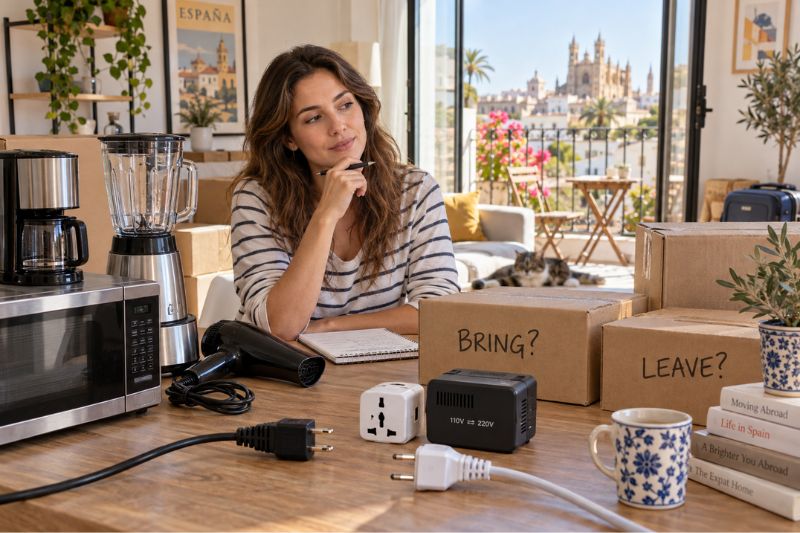
For many Americans, moving to Spain does not happen in one clean, perfectly timed shipment. Even with careful planning, life rarely lines up that neatly. Housing decisions take longer than expected, visa approvals arrive later than hoped, and temporary living arrangements often become part of the transition.
That is why staged moves to Spain from the USA are far more common than most people realize.
A staged move means shipping household goods in phases rather than all at once. Some items arrive early, others later, and some stay in storage until the right moment. This approach is not a sign of poor planning. In fact, for Americans relocating internationally, it is often the most practical and least stressful way to handle a complex life change. If you’re planning a move from the U.S. to Spain, our international movers to Spain overview walks through the full process.
Whether you are renting short-term in Spain, waiting to buy property, downsizing after arrival, or simply unsure what you will truly need, a staged move allows flexibility when certainty is not yet possible. Instead of forcing every decision before departure, you give yourself room to adapt once you are on the ground.
This article explains how Americans use staged moves to Spain, how shipping and storage fit into that strategy, and how timing decisions are made when everything does not happen at once. If you are planning a move from the U.S. to Spain, our international movers to Spain overview walks through the full process.
What a “Staged Move” to Spain Actually Means
A staged move is an international relocation where household goods are shipped in more than one phase instead of a single, all-encompassing shipment.
In a traditional move, everything is packed, shipped, cleared through customs, and delivered in one sequence. With a staged move, that process is intentionally broken into steps. Some items are shipped right away, while others remain in storage or are shipped later once housing, lifestyle, and long-term needs become clearer.
For Americans moving to Spain, staged moves usually fall into a few broad patterns.
Some people ship only essential household items initially. These might include clothing, basic furniture, kitchen necessities, or items needed for daily life. Larger or less critical belongings stay behind in secure storage until permanent housing is secured.
Others divide shipments by function. Personal effects and everyday items arrive first, while decorative pieces, extra furniture, or sentimental belongings are shipped later once the household has settled and space constraints are understood.
There are also situations where timing alone drives the decision. A family may need to vacate a U.S. home before their Spanish lease begins. A retiree may want to live in Spain for several months before deciding what furniture truly fits their new lifestyle. A remote worker may relocate quickly for residency purposes while delaying the bulk of their shipment.
What matters most is that a staged move is planned intentionally. Storage, shipping methods, customs documentation, and delivery timing are coordinated from the start, even if the exact delivery dates remain flexible.
This approach is especially common for Americans because international moves to Spain involve more variables than domestic relocations. Housing layouts differ, building access can be unpredictable, and lifestyle adjustments often lead people to reevaluate what they actually want to live with.
A staged move gives you control over those decisions rather than forcing them all before departure.
Why Americans Choose Staged Moves When Relocating to Spain
A staged move is rarely about making things more complicated. It’s usually about making the move survivable and sane.
When Americans relocate internationally, the hardest part is not always the shipping. It’s that the shipping has to fit into a life transition where the big pieces are still moving. Housing is not final yet. Your visa timeline might be in progress. Work start dates shift. School enrollment gets delayed. Your U.S. home may sell faster or slower than expected.
Staged moves are how people build flexibility into a process that has real-world uncertainty.
Housing is often temporary at first
One of the most common reasons Americans stage their move is simple: they do not have a long-term address in Spain yet.
Many people arrive in a short-term rental, serviced apartment, or temporary housing while they learn neighborhoods, commute patterns, and what daily life actually feels like. That is especially true in competitive markets where signing a lease can move quickly, or where people want to see a place in person before committing.
Shipping an entire household before you know your square footage, storage space, building access, or whether the elevator is actually usable is one of the easiest ways to create stress right at the moment you are trying to settle in.
A staged move lets you arrive with what you need, then make smarter decisions once your housing is stable.
The “what do we actually need?” question gets answered after arrival
Before you leave the U.S., everything can feel essential. Once you land in Spain, priorities often change.
Homes may be smaller than what you are used to. Storage might be limited. Certain furniture fits differently. Some Americans discover they love the lighter, simpler feel of their new space. Others realize they miss specific items that made their home feel like home.
Staging gives you room to learn what matters without forcing every decision while you are still overwhelmed with paperwork and planning. If you’re still debating what’s worth bringing, your guide on what to bring when moving to Spain can help you think through the decision from a practical standpoint, not just an emotional one.
Timing conflicts are normal, not a sign you did something wrong
Real-life deadlines rarely line up perfectly.
Sometimes your U.S. lease ends before your Spain lease begins. Sometimes you need to relocate quickly for work or residency reasons, but the rest of the household needs time to sort out. Sometimes selling a home dictates the schedule more than anything else.
A staged move gives you options when the calendar isn’t cooperating.
It also helps you avoid the pressure of trying to synchronize everything into one do-or-die shipment. If you’ve already read our international moving timeline to Spain article, think of staged moves as a way to keep your timeline realistic and forgiving, even when life is not.
Decision fatigue is real, and staged moves reduce it
International relocations come with nonstop decisions: visas, healthcare, banking, schooling, taxes, housing, what to sell, what to keep, what to store, what to ship.
Many Americans discover that the most helpful strategy is not trying to solve everything in advance. It’s solving the first phase well, then making the second phase decisions with more clarity.
That’s what staging really is. It’s not delaying the move. It’s sequencing it.
Shipping Household Goods in Phases From the USA to Spain
When Americans plan a staged move to Spain, shipping decisions are usually made in layers rather than all at once. Instead of asking “How do we ship everything,” the more useful question becomes “What do we need first, and what can wait?”
That shift alone tends to reduce stress.
What usually goes in the first shipment
The first shipment is typically focused on functionality, not completeness. Americans often prioritize items that support daily life and help them feel settled quickly.
This can include clothing for the current season, basic furniture, kitchen essentials, work equipment, and personal items that are difficult or expensive to replace. For families, it may also include children’s items that help create continuity during a big transition.
The goal of the first phase is not to recreate your U.S. home immediately. It’s to make your new place in Spain livable while you learn how you’ll actually use the space.
What commonly waits for a later shipment
Items that are less critical to daily routines are often better shipped later.
Decorative furniture, artwork, additional seating, guest room items, and sentimental belongings are commonly held back until housing is finalized. Once Americans understand room sizes, storage limitations, and how Spanish buildings function, these decisions become much easier and more confident.
This is also where many people realize they want fewer items than they originally planned. Understanding how household goods shipping to Spain works at a practical level helps people right-size their later shipments instead of sending everything by default:
https://www.movertospain.com/household-goods-shipping-to-spain/
Using different shipping methods within a staged move
Staged moves also allow Americans to mix shipping methods strategically.
Some people choose to send a very small number of essentials by air freight so they have immediate access to key items upon arrival. Others rely entirely on sea freight but split shipments into separate phases. What matters is not the method itself, but how it supports your overall plan.
Because SDC handles household goods shipments in containers, phased shipping can be coordinated in a way that keeps everything documented and organized from the beginning. Even if shipments move at different times, the planning happens upfront so nothing feels improvised later.
Why planning both phases early still matters
Even though shipments happen in stages, both phases should be planned together.
Customs documentation, inventories, and packing standards need to align so later shipments do not create unnecessary complications. When staged moves are treated as one cohesive plan rather than separate events, the entire process tends to feel smoother and more predictable.
This is where working with movers who regularly handle Spain relocations makes a difference. They plan for flexibility without losing structure.
Storage Strategies That Support Staged Moves to Spain
Storage is not a backup plan in a staged move. It is part of the strategy.
For many Americans, storage provides the breathing room needed to make thoughtful decisions instead of rushed ones. The key is understanding how storage fits into an international relocation, not treating it as an afterthought.
Short-term vs longer-term storage decisions
Some people only need storage for a short window. This might happen when housing dates don’t line up perfectly, or when a second shipment is planned a few months after arrival.
Others intentionally choose longer-term storage while they test life in Spain before committing to shipping everything. This is especially common for retirees and remote workers who want to experience their new routine before finalizing what stays in the U.S. and what comes overseas.
Neither approach is right or wrong. What matters is choosing storage that aligns with your timeline, not forcing your timeline to fit the storage.
Storing household goods in the U.S. versus Spain
Many Americans assume storage must happen in the U.S., but that is not always the case.
U.S.-based storage is often used when people are still finalizing housing in Spain or want to delay international shipping entirely. Spain-based storage can make sense when goods are already shipped but delivery is postponed until housing is ready.
Each option has implications for customs planning and delivery coordination. That’s why storage decisions are best made alongside your shipping plan, not after everything is packed.
If storage is likely to be part of your move, learning how international storage services integrate with shipping and customs can help you avoid surprises later. https://www.movertospain.com/secure-storage-spain/
Why professional packing matters even more when items go into storage
Items that go into storage are often the items people care about most. Furniture, artwork, family heirlooms, and decorative pieces are commonly stored while people settle in.
Professional packing becomes especially important in these situations because items may sit for months before being unpacked. Proper materials, detailed inventories, and careful handling help ensure that when those items are finally delivered, they arrive in the condition you expect.
Storage as a flexibility tool, not a delay
The biggest misconception about storage is that it means the move is stalled.
In reality, storage gives you control. It allows you to move forward with residency, housing, and daily life in Spain while keeping options open about the rest of your household goods.
For many Americans, that flexibility is what makes a staged move feel manageable rather than overwhelming.
Timing a Staged Move Around Visas, Housing, and Life Transitions
One of the biggest advantages of a staged move is that it allows your shipping plan to adapt to real life, not the other way around. For Americans relocating to Spain, timing rarely unfolds in a neat sequence. Visas, housing, work, and family commitments often move on different schedules.
Instead of trying to force everything into a single departure and delivery window, staged moves give you flexibility when certainty is still developing.
Visa timelines often determine when you move, not when your goods arrive
For many Americans, visa approval dictates when they must be physically present in Spain, even if long-term housing is not finalized. This is especially common with non-lucrative visas, work authorizations, and family-based residency paths.
A staged move allows you to relocate when your visa requires it, without rushing your entire household shipment before you are ready. Essential items can arrive first, while the rest of your belongings wait until your living situation becomes clearer.
If you are trying to understand how shipping schedules usually align with relocation planning, it helps to see how international moving timelines to Spain typically unfold in practice, especially when shipments are coordinated in phases rather than all at once:
International Moving Timeline to Spain
Housing transitions rarely line up perfectly
Selling a home in the U.S., ending a lease, or securing long-term housing in Spain often introduces gaps. Some Americans arrive in Spain specifically to search for housing in person, while others start in short-term rentals that are not suitable for full household deliveries.
Staged moves absorb this uncertainty. Instead of delivering furniture into temporary housing that cannot accommodate it, you maintain control over when and where your belongings arrive. Once housing details are confirmed, delivery planning becomes far more straightforward.
Life does not pause just because you are relocating internationally
Family schedules, work obligations, school calendars, and personal readiness all influence timing. Children may start school mid-year. One partner may relocate first while the other follows later. Retirees may want time in Spain before fully committing.
Staged moves allow Americans to move forward without waiting for every detail to be perfect. Rather than chasing an ideal timeline, they create a realistic one that supports the transition as it unfolds.
Common Staged Move Mistakes Americans Make and How to Avoid Them
Staged moves are flexible by design, but flexibility still needs structure. Most problems do not come from staging itself, but from staging without a clear plan.
Shipping too much too early
One of the most common mistakes is sending a full household shipment before understanding the realities of Spanish housing. Items that felt essential in the U.S. can quickly become obstacles in smaller spaces or buildings with limited access.
Taking a more conservative first shipment allows you to learn first, then decide.
Underestimating how long storage might be needed
Many people plan for short-term storage and then discover that housing decisions take longer than expected. While this is normal, it can feel stressful if storage was not factored into the plan from the beginning.
When storage is anticipated rather than reactive, it becomes a stabilizing part of the move rather than a frustration.
Treating later shipments as separate moves
A staged move should feel like one coordinated relocation, not multiple unrelated ones.
Customs documentation, inventories, and packing standards should be aligned from the start. When later shipments are planned as an extension of the first, the process stays smoother and more predictable.
This is where experience matters. Movers who regularly coordinate phased international relocations understand how to keep everything connected, even when deliveries happen months apart.
Choosing a mover who cannot support staged strategies
Not all international movers are equipped to handle staged moves well. Some are set up for one-time shipments only and struggle when plans evolve.
Working with a mover who understands that timing, housing, and personal circumstances change is essential. If you’re planning a move from the U.S. to Spain, our international movers to Spain overview walks through how experienced coordination makes these situations easier, not harder.
How SDC Helps Americans Plan and Execute Staged Moves to Spain
A staged move works best when it is treated as one coordinated relocation, not a series of disconnected shipments. This is where experienced guidance makes a meaningful difference.
At SDC International Shipping, staged moves are planned from the very beginning, even when the details are still evolving. Instead of forcing clients to lock in decisions too early, the focus is on building a flexible plan that can adapt as housing, visas, and life circumstances come into focus.
The process usually starts with a conversation, not a checklist. Understanding where you are in your planning, what is still uncertain, and what matters most helps shape a shipping and storage strategy that fits your situation. Some clients know they will ship in two phases. Others are unsure and want options. Both are valid starting points.
From there, packing, freight coordination, storage planning, and customs preparation are handled as part of a single roadmap. Even if shipments move at different times, the documentation, inventories, and packing standards are aligned so nothing feels improvised later. This consistency is especially important when household goods spend time in storage or when deliveries are scheduled after arrival in Spain.
Another key role SDC plays is acting as a steady point of contact as plans change. Housing timelines shift. Delivery dates move. Life happens. Having one team that understands the full scope of your move makes it easier to adjust without restarting the process or losing momentum.
Most importantly, staged moves are never treated as a problem to solve. They are treated as a normal, practical response to the realities of international relocation. Americans moving to Spain often need flexibility more than certainty, and the goal is to support that without adding stress.
When done well, a staged move gives you control over your transition. You arrive in Spain focused on settling in, not managing logistics from afar. Your household goods follow a plan that matches your life, rather than forcing your life to fit a shipment.