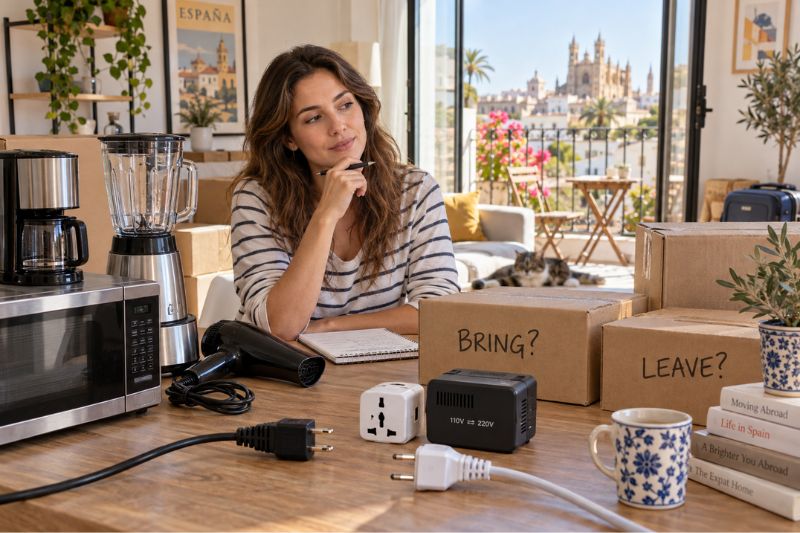
Moving to Spain Without Knowing If It’s Forever
For many Americans, the move to Spain begins with a quiet qualifier.
“We’re going to try it for a year.”
“Let’s see how it feels.”
“We’re open to staying, but not promising anything.”
This mindset is more common than people admit, and it often brings mixed emotions. On one hand, there’s excitement. On the other, there’s hesitation. People worry that treating the move as temporary makes it less valid, or that they should either commit fully or not go at all.
That pressure is unnecessary.
Spain attracts people who are curious, not reckless. Retirees exploring a new pace of life. Professionals taking advantage of remote work. Families wanting international experience without burning bridges at home. In all of these cases, the move is real, even if the timeline is open-ended.
What creates stress is the assumption that logistics require emotional certainty. That to plan a proper international move, you must already know whether this is permanent.
In reality, many successful relocations to Spain start without that answer.
Moves can be structured to support both outcomes, staying or returning, without forcing a decision too early. The goal is not to pretend the move is temporary forever, but to allow it to become permanent only if and when it feels right.
If you’re still orienting yourself to how international relocations to Spain are typically structured, this overview of the process helps ground where flexible, open-ended moves naturally fit:
https://www.movertospain.com/international-moving-to-spain/
Why “Temporary” Moves Are Often the Most Thoughtful Ones
A move that begins as temporary is not a lack of commitment. It’s often a sign of self-awareness.
People who label their move as “permanent” before arrival are usually doing so to calm anxiety, not because they truly know how life will unfold. Spain is layered, and daily living often feels very different from expectations formed at a distance.
Those who allow the move to be exploratory tend to make better long-term decisions.
They give themselves space to learn how Spain fits into their routines, relationships, and identity. They notice whether the lifestyle energizes them or drains them. They discover which compromises feel worthwhile and which do not.
From a planning standpoint, this mindset encourages flexibility rather than avoidance. Instead of overcommitting or undercommitting, people focus on reversibility.
What decisions can be changed later.
What should stay light at first.
What needs to be protected regardless of outcome.
This is where experienced movers think differently. A move designed to support both staying and returning is not half a move. It is a resilient move.
Household shipments can be right-sized. Storage can remain part of the plan. Insurance can reflect multiple possible paths. Timelines can breathe. None of this makes the move less real. It makes it more adaptable.
If you’re planning a move from the U.S. to Spain and want to understand how professionals think about flexible, open-ended relocations, our international movers to Spain overview walks through the full process without assuming permanence from day one.
Planning a Move That Works Whether You Stay or Return
When a move might become permanent, but isn’t guaranteed to, the most important planning principle is option preservation.
This does not mean keeping one foot out the door. It means avoiding decisions that force an outcome before you’re ready.
Experienced movers approach open-ended relocations by separating arrival needs from long-term commitments. What you need to live comfortably in Spain during the first phase is often different from what you would want if you knew you were staying indefinitely.
That distinction shapes how shipping is planned.
Instead of sending everything at once, many people prioritize essentials and meaningful items first. Secondary belongings remain in storage or stay behind until the direction of the move becomes clearer. This reduces emotional weight and keeps future choices open.
Storage plays a particularly important role here. Storage is not indecision. It is intentional breathing room. It allows your belongings to be protected without forcing you to decide their final destination too early.
Insurance should also be aligned with this mindset. Coverage should follow belongings through transit, storage, and potential future movement, not assume a single, final endpoint. When protection matches reality, uncertainty stops feeling risky.
For people unfamiliar with how storage fits into flexible international moves, this overview offers helpful context:
https://www.movertospain.com/secure-storage-spain/
The goal is not to delay decisions forever. It is to make them when they’re informed by experience, not fear of getting it wrong.
The Difference Between Flexibility and Hesitation
One of the most common internal struggles during a temporary-but-maybe-permanent move is the fear of hesitation.
People worry they are being noncommittal. That they’re “half moving.” That they should either go all in or not go at all.
In practice, flexibility and hesitation are not the same thing.
Hesitation avoids decisions because of fear.
Flexibility designs decisions so they can evolve.
A flexible move has intention behind it. It acknowledges uncertainty and plans for it. It does not leave things vague or unmanaged. In fact, it often requires more planning, not less.
The people who struggle most with open-ended moves are usually the ones who try to resolve uncertainty prematurely. They overcommit to prove seriousness, or undercommit to protect themselves. Both approaches create tension.
A resilient move accepts that some answers will come later.
You don’t need to know how long you’ll stay to plan responsibly.
You don’t need to choose permanence to justify a professional move.
You don’t need to decide your future before you arrive.
What you need is a structure that works regardless of outcome.
That is where experienced international movers add real value, not by pushing decisions forward, but by ensuring decisions don’t box you in.
How SDC Supports Moves That May Become Permanent Over Time
At SDC International Shipping, we regularly work with clients whose move to Spain begins as temporary and evolves naturally.
These moves are not treated as provisional or incomplete. They are treated as open-path relocations.
From the beginning, we discuss how to keep options available without sacrificing protection or organization. Shipping plans are right-sized. Storage is positioned as a strategy, not a fallback. Insurance is aligned with multiple potential futures.
Clients are never asked to define permanence upfront. Instead, we focus on what they need now, what they may need later, and how to move between those phases smoothly.
This approach removes pressure.
People can settle into Spain without feeling like they’ve closed doors behind them. If the move becomes permanent, scaling up feels natural. If plans change, scaling back does not feel like failure.
That emotional steadiness is just as important as logistics.
Reframing “Temporary” as Intentional, Not Uncertain
One of the most important shifts people make during an open-ended move is changing how they interpret the word temporary.
Temporary does not mean unstable.
Temporary does not mean unserious.
Temporary does not mean reversible failure.
In many cases, it simply means undecided on purpose.
Moves that begin this way often lead to better long-term outcomes because they allow identity, routine, and place to align naturally. Instead of forcing certainty, people let Spain show them how it fits into their lives.
This reframing also removes unnecessary self-judgment. You are not required to know the ending before you begin. You are allowed to arrive, live, adjust, and then decide.
From a practical standpoint, intentional temporary moves are often the most carefully planned. They rely on flexibility, protection, and thoughtful pacing rather than assumptions. They leave room for growth in either direction.
Many people eventually realize that permanence reveals itself quietly. Not through a declaration, but through comfort. Through routines that stick. Through a sense that returning would feel harder than staying.
Others discover that Spain gave them exactly what they needed, even if it wasn’t forever. Both outcomes are valid.
What matters is that the move supports you while the answer emerges.
A Move Can Be Real Without Being Final
One of the most freeing realizations for people moving to Spain is that finality is not a prerequisite for commitment.
You can move well without moving permanently.
You can plan responsibly without closing doors.
You can invest emotionally without locking in a future you haven’t lived yet.
A well-structured international move is not defined by how long it lasts. It is defined by how well it supports the person making it.
If your move to Spain begins as temporary and evolves naturally, that evolution is not a correction. It’s the point.
If you’re preparing for an open-ended relocation and want to make sure your move is designed to support both staying and returning, the most helpful next step is to talk through that flexibility before assumptions harden into commitments.
Call (844) 651-7050 to speak with a relocation specialist or visit
https://www.movertospain.com/get-a-quote/ to start planning your move.