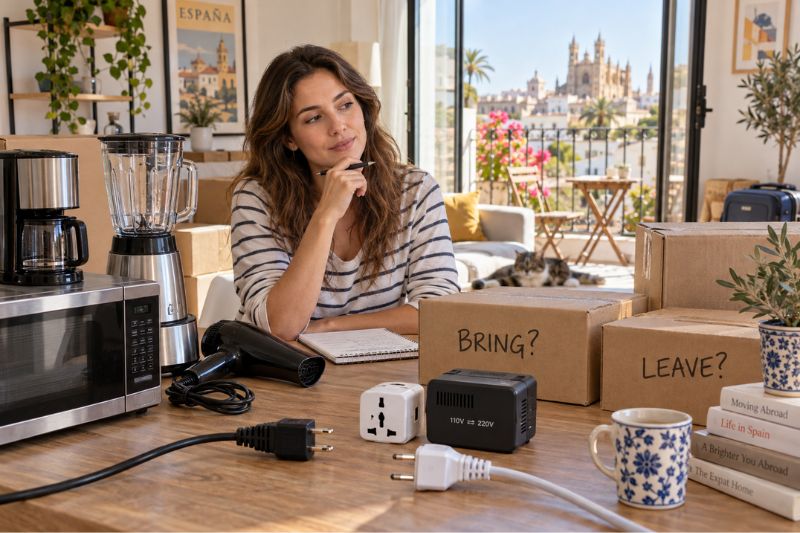
Why Knowing What Not to Ship Matters
When Americans plan a move to Spain, most focus on what to bring.
The dining table. The bedroom set. The artwork. The family heirlooms. But one of the most important parts of international relocation is understanding what not to ship.
Shipping items that are restricted, impractical, or incompatible can lead to customs delays, added costs, or unnecessary stress just when you are trying to start a new chapter abroad. For retirees, couples, and small-to-medium households, avoiding preventable complications makes the transition smoother and more predictable.
International moving is not simply a larger version of a domestic move. Spain has its own import regulations, documentation requirements, and standards. Knowing these in advance allows you to pack strategically instead of reactively.
This article is not about creating anxiety. It is about clarity. When you understand what should stay behind, your shipment becomes cleaner, your inventory becomes simpler, and your arrival in Spain feels more controlled.
Restricted and Prohibited Household Items
Spain, like all countries, regulates what can legally enter its borders. While most normal household goods are permitted when tied to a residency move, certain items are restricted or prohibited entirely.
Hazardous Materials
Items considered hazardous are generally not permitted in international household shipments. This includes:
- Paints and paint thinners
- Gasoline or fuel containers
- Propane tanks
- Fireworks or ammunition
- Certain cleaning chemicals
Even partially used containers stored in a garage can cause complications if packed accidentally. These items should be properly disposed of before packing day.
Professional packing crews are trained to identify restricted materials, but reviewing your storage areas in advance helps prevent last-minute surprises.
Perishable Food and Organic Materials
While it may be tempting to ship pantry goods or specialty food items, many food products are restricted or subject to strict regulation. Fresh foods, open containers, and certain organic materials can trigger inspection or rejection.
Unopened dry goods are sometimes permitted under specific circumstances, but they are rarely worth the complication. Most American pantry staples are available in Spain, particularly in larger cities with international communities.
When in doubt, it is often simpler to start fresh with food once you arrive.
Weapons and Controlled Items
Firearms and other controlled items require special documentation and approval, and in many cases are not advisable to include in a standard household shipment. Regulations vary and can be strict.
If you own any such items, consult professionals well in advance rather than assuming they can be packed with general household goods.
Understanding these categories early allows you to declutter confidently.
Items That Are Technically Allowed but Often Not Practical
Not everything that is legally permitted is wise to ship.
Many items can technically be imported into Spain as part of a household move, but that does not mean they are practical, cost-effective, or well-suited to your new home.
Understanding this distinction helps you avoid paying to transport items that will not serve you once you arrive.
Oversized American Furniture
Large sectional sofas, oversized recliners, king-sized bedroom suites with bulky dressers, and heavy entertainment centers are common in U.S. homes. In Spain, particularly in city apartments, layouts are often narrower and more compact.
Doorways may be tighter. Elevators may be smaller. Staircases may curve sharply.
Even if a piece clears customs without issue, it may not fit comfortably into your Spanish residence. Before deciding to ship large furniture, compare its dimensions against realistic floor plans abroad.
If you are unsure how shipment size impacts coordination, our household goods shipping to Spain page explains how volume influences container structure and delivery logistics.
Shipping less often simplifies everything, from freight planning to final placement.
Inexpensive or Easily Replaceable Items
It rarely makes sense to ship low-cost items that are readily available in Spain. Basic bookshelves, mass-produced decor, older mattresses, and inexpensive kitchenware can usually be replaced locally without difficulty.
Spain has strong retail options at multiple price levels, especially in larger cities. Bringing only what truly adds comfort or personal meaning often creates a more intentional home abroad.
Appliances Designed for U.S. Standards
Small kitchen appliances and electronics designed specifically for U.S. voltage standards may not function properly in Spain without transformers. Even with converters, long-term use can reduce lifespan or performance.
Before packing items like coffee makers, microwaves, hair dryers, or specialized equipment, consider whether replacing them locally is more practical.
Technically allowed does not always mean strategically smart.
Electrical and Compatibility Issues
Electrical compatibility is one of the most common oversights in international moves.
The United States and Spain operate on different voltage systems. Plug types differ. Appliance design expectations differ.
Voltage Differences
Most U.S. appliances operate on 110–120 volts. Spain operates on 220–240 volts. While plug adapters are simple, voltage differences are not.
Some electronics, such as laptops and phone chargers, are dual voltage and adapt easily. Others are not. Running incompatible appliances through converters long-term is rarely ideal.
Shipping large appliances is typically not advisable unless they are specifically designed to operate internationally.
Size and Installation Standards
Beyond voltage, installation standards can differ. Built-in appliances, washers, dryers, and refrigerators may not align with European kitchen layouts or plumbing configurations.
Rather than assuming compatibility, evaluate whether replacement in Spain would simplify your transition.
Shipping fewer electrical items often reduces both customs scrutiny and delivery complications.
Food, Liquids, and Regulated Goods
Food and liquid items deserve special attention before any international shipment.
Even when tied to a residency move, certain categories can trigger inspection, delay, or refusal at customs. Fresh food, opened containers, homemade products, and perishable goods are almost always problematic. Even sealed products can fall into regulated categories depending on their ingredients.
Alcohol is another area that requires caution. While limited quantities may sometimes be permitted under specific conditions, importing alcohol is subject to regulation and documentation requirements. It is rarely worth the administrative complexity for everyday household moves.
Liquids in general present transport challenges. Cleaning supplies, partially used containers, and garage-stored chemicals should be reviewed carefully before packing day.
For a broader understanding of how documentation and inspection work during the import process, our Spain customs forms and documentation guide outlines the preparation steps you should review before shipment.
Knowing these restrictions ahead of time prevents stressful last-minute removals from your shipment.
Common Mistakes Americans Make
Even well-organized households make predictable mistakes when moving internationally.
Understanding these patterns can help you avoid them entirely.
Assuming “If I Own It, I Can Ship It”
Ownership does not automatically equal import eligibility. Customs authorities focus on regulation and classification, not personal attachment.
Reviewing questionable items in advance avoids surprises once your shipment reaches port.
Packing Garage and Storage Areas Last
Garages, sheds, and storage closets often contain exactly the items most likely to cause complications. Paint cans, fuel containers, outdoor chemicals, and miscellaneous regulated materials are commonly discovered on packing day.
Clearing these areas early gives you time to dispose of restricted items responsibly.
Shipping Out of Sentiment Instead of Strategy
When leaving a long-time home, it is easy to over-ship.
Large furniture that does not fit Spanish layouts, appliances that are incompatible with voltage standards, and inexpensive items that can be replaced locally are often included simply because they are familiar.
A more strategic approach reduces freight complexity and simplifies delivery on arrival.
How to Avoid Customs Delays and Extra Stress
The simplest way to avoid customs issues is preparation.
Before packing begins, walk through your home with a critical eye. Separate items into three categories:
- Clearly appropriate for shipment
- Replaceable in Spain
- Questionable or potentially restricted
If there is uncertainty, ask before packing.
If you’re planning a move from the U.S. to Spain, our international movers to Spain overview walks through the full process.
Seeing the relocation sequence clearly helps you understand how shipment planning, documentation, and customs coordination work together.
When your shipment is clean, intentional, and compliant, everything moves more smoothly.
At SDC International Shipping, our role is not just transportation. It is guidance. We help you identify what makes sense to ship and what is better left behind so that your transition to Spain feels organized rather than uncertain.
When you are ready to review your shipment plan with an experienced relocation specialist, you can start planning your move to Spain and take the next step with clarity.
Moving to Spain is an exciting transition. Knowing what not to ship makes it even smoother.